

Keyword research is one of the most important parts of digital marketing, blogging, SEO, affiliate marketing, and content creation. No matter how well-written a blog post or website is, it may struggle to rank on search engines if the right keywords are not targeted. This is why keyword research tools have become essential for creators, marketers, and businesses.
Don’t Miss: Essential WordPress Plugins for Bloggers
Keyword research helps creators understand what people are searching for online. It allows bloggers and website owners to create content based on user interests, search trends, and audience needs. The right keywords can improve search engine rankings, increase website traffic, and attract the right audience.
Today, competition on Google and other search engines has become extremely high. Millions of articles are published every day, making SEO more competitive than ever. Keyword research tools help creators discover profitable topics, analyze competitors, and identify ranking opportunities.
Whether someone is a beginner blogger, affiliate marketer, YouTuber, or business owner, using keyword research tools can significantly improve online growth and visibility.
In this guide, we will explore the essential keyword research tools that help creators build smarter SEO strategies in 2026.
Why Keyword Research Tools Matter?
Ahrefs is one of the most powerful SEO and keyword research tools available today. It is widely used by bloggers, SEO experts, businesses, and affiliate marketers.
Key Features
- Keyword Explorer
- Competitor analysis
- Backlink tracking
- Site audits
- Content gap analysis
- SERP analysis
Advantages
Massive Keyword Database
Ahrefs provides keyword data from multiple countries and search engines.
Strong Competitor Analysis
Users can study competitors’ rankings and strategies.
Detailed SEO Insights
The platform offers deep keyword difficulty and traffic analysis.
Disadvantages
Expensive Pricing
Ahrefs may be costly for beginners.
Learning Curve
Advanced features may require SEO knowledge.
Best For
- Professional bloggers
- SEO experts
- Affiliate marketers
2. SEMrush
SEMrush is another highly popular SEO platform used for keyword research, traffic analysis, and digital marketing.
Key Features
- Keyword Magic Tool
- Competitor research
- PPC analysis
- Rank tracking
- SEO content templates
Advantages
All-in-One Marketing Platform
SEMrush combines SEO, advertising, and analytics tools.
Excellent Keyword Suggestions
Provides large keyword variations and related topics.
Strong Reporting Tools
Useful for agencies and businesses.
Disadvantages
Premium Pricing
Advanced plans can become expensive.
Complex Interface
Beginners may need time to learn the platform.
Best For
- Businesses
- Agencies
- Content marketers
3. Google Keyword Planner
Google Keyword Planner is a free keyword research tool provided by Google Ads.
Key Features
- Search volume estimates
- Keyword suggestions
- Competition analysis
- PPC keyword research
Advantages
Free to Use
Beginners can access valuable keyword data without large costs.
Direct Google Data
Provides information directly from Google.
Simple Interface
Easy for new users to understand.
Disadvantages
Limited SEO Data
Primarily designed for advertisers.
Broad Search Volume Ranges
Some data lacks precise numbers.
Best For
- Beginners
- Bloggers
- Small businesses
4. Ubersuggest
Ubersuggest is a beginner-friendly SEO and keyword research tool developed by Neil Patel.
Key Features
- Keyword ideas
- SEO analysis
- Domain overview
- Traffic estimates
- Content suggestions
Advantages
Affordable Pricing
Cheaper than many premium SEO platforms.
Beginner Friendly
Simple dashboard and easy navigation.
Useful Content Ideas
Suggests trending article topics.
Disadvantage
Limited Advanced Features
Not as powerful as Ahrefs or SEMrush.
Best For
- Beginners
- Bloggers
- Freelancers
5. Moz Keyword Explorer
Moz is a trusted SEO platform known for its keyword research and domain authority metrics.
Key Features
- Keyword difficulty analysis
- SERP analysis
- Organic CTR data
- Priority scoring
Advantages
User-Friendly Interface
Easy to understand for beginners.
Reliable SEO Metrics
Moz Domain Authority is widely respected.
Helpful Learning Resources
Great educational content for SEO beginners.
Disadvantages
Smaller Database
Less extensive compared to Ahrefs.
Premium Plans Required
Advanced tools require subscriptions.
Best For
- SEO learners
- Bloggers
- Small businesses
6. AnswerThePublic
AnswerThePublic focuses on question-based keyword research and content ideas.
Key Features
- Search question analysis
- Visual keyword maps
- Content topic ideas
- Long-tail keyword research
Advantages
Great for Content Ideas
Helps creators understand audience questions.
Useful for Long-Tail Keywords
Excellent for blog and YouTube content planning.
Disadvantage
Limited SEO Metrics
Does not provide deep competitor analysis.
Best For
- Bloggers
- YouTubers
- Content creators
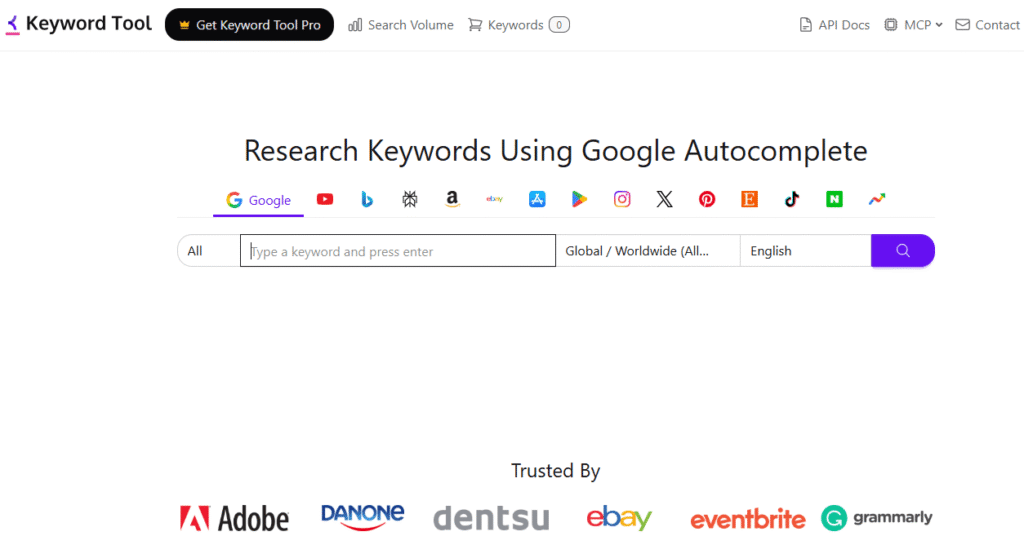
7. KeywordTool.io
KeywordTool.io generates keyword suggestions from Google, YouTube, Bing, Amazon, and social media platforms.
Key Features
- Long-tail keyword generation
- YouTube keyword research
- Amazon keyword suggestions
- Multi-platform support
Advantages
Great for Multiple Platforms
Useful beyond traditional Google SEO.
Strong Long-Tail Keywords
Helpful for niche targeting.
Disadvantage
Limited Free Features
Advanced data requires paid plans.
Best For
- YouTubers
- E-commerce sellers
- Bloggers
Benefits of Using Keyword Research Tools Together:
Many SEO professionals combine multiple tools for better accuracy and insights.
Example workflow:
- Use Ahrefs for competitor analysis
- Use SEMrush for keyword variations
- Use AnswerThePublic for content ideas
- Use Google Keyword Planner for search volume
- Use Surfer SEO for optimization
This combination creates stronger SEO strategies and better ranking opportunities.
Important Features to Look For:
Search Volume
Shows how often keywords are searched.
Keyword Difficulty
Indicates ranking competition.
Competitor Analysis
Helps study successful websites.
Long-Tail Keywords
Useful for targeted traffic and lower competition.
SERP Analysis
Shows current ranking pages.
Common Keyword Research Mistakes:
Targeting Only High-Volume Keywords
High competition makes ranking difficult.
Ignoring Search Intent
Content should match what users actually want.
Keyword Stuffing
Overusing keywords reduces readability and SEO quality.
Avoiding Long-Tail Keywords
Specific keywords often convert better.
Ignoring Competitor Analysis
Competitor research helps identify opportunities.
Tips for Better Keyword Research
Focus on User Intent
Understand why users search specific terms.
Combine Short and Long Keywords
Balanced strategies improve traffic potential.
Study Competitors
Analyze what works in your niche.
Update Research Regularly
Search trends change over time.
Prioritize Content Quality
Good content matters more than keywords alone.
How AI Is Changing Keyword Research?
Artificial intelligence is transforming SEO rapidly.
AI-powered keyword tools now help marketers:
- Predict keyword trends
- Generate topic ideas
- Analyze user intent
- Suggest optimization strategies
- Automate competitor research
AI is making SEO faster and more data-driven.
Future of Keyword Research Tools:
Keyword research tools are evolving rapidly as search engines, artificial intelligence, and user behavior continue changing. In the future, these tools are expected to become much smarter, more automated, and heavily focused on understanding search intent rather than simply analyzing keywords. As competition in digital marketing grows, creators and businesses will rely even more on advanced keyword research platforms to improve SEO performance and online visibility.
One of the biggest trends shaping the future of keyword research tools is artificial intelligence. AI-powered platforms are already helping marketers generate keyword ideas, predict trends, analyze competitors, and optimize content. In the future, AI may automatically create complete SEO strategies based on audience behavior, search patterns, and market trends.
Search intent analysis is expected to become even more important. Modern search engines no longer focus only on exact keywords; they also analyze the meaning and purpose behind searches. Future keyword tools may provide deeper insights into why users search specific phrases and what type of content best satisfies those searches.
Predictive SEO is another major future trend. Advanced keyword tools may use AI and machine learning to forecast future search trends before they become highly competitive. This would allow creators to target emerging topics earlier and gain ranking advantages.
Voice search optimization is likely to influence keyword research significantly as well. More people are using voice assistants and conversational AI systems to search online. Future keyword tools may focus heavily on natural language queries, question-based searches, and conversational keywords.
Another important development is real-time keyword tracking. Future tools may provide live search trend updates, audience behavior analysis, and instant ranking changes. This could help marketers react more quickly to viral topics and changing search patterns.
Personalization may also become more advanced. Future keyword research platforms could generate custom keyword suggestions based on a creator’s niche, audience demographics, content style, and historical performance. This would make SEO strategies more targeted and efficient.
Competitor analysis tools are expected to become smarter too. Future platforms may automatically analyze competitor content, backlink strategies, ranking weaknesses, and content gaps while providing actionable recommendations for outranking them.
AI-generated content integration may become more common as well. Future keyword research tools could directly connect with AI writing assistants to generate optimized article outlines, blog topics, headings, and SEO-friendly content recommendations automatically.
Another growing trend is multi-platform keyword research. Search behavior is expanding beyond traditional Google searches. People now search on platforms like YouTube, TikTok, Pinterest, and Amazon. Future keyword tools may provide more advanced insights across multiple platforms instead of focusing only on search engines.
Visual search and image-based SEO may also influence future keyword research. As image recognition technology improves, keyword tools may help optimize content for visual search systems and AI-driven discovery platforms.
Automation will likely become much stronger too. Future platforms may automatically suggest content calendars, identify ranking opportunities, optimize existing articles, and monitor SEO performance without heavy manual analysis.
However, despite these technological advancements, human creativity and content quality will still remain extremely important. Search engines continue prioritizing valuable, trustworthy, and engaging content. The best SEO strategies in the future will likely combine advanced keyword tools with authentic and useful content creation.
Privacy changes and search engine algorithm updates may also affect future keyword research methods. Tools may need to adapt to stricter data regulations and evolving ranking systems.
Overall, the future of keyword research tools looks highly AI-driven, predictive, and automation-focused. These platforms will continue helping creators and businesses discover opportunities faster, understand audiences better, and build smarter SEO strategies in an increasingly competitive digital landscape.
Final Verdict:
Keyword research tools play a major role in modern SEO and digital marketing. Platforms like Ahrefs, SEMrush, Ubersuggest, Google Keyword Planner, and AnswerThePublic help creators discover profitable keywords and improve search visibility.
The best tool depends on experience level, budget, and marketing goals. Beginners may prefer free or affordable platforms, while advanced marketers often require professional SEO suites.
However, keyword research alone is not enough for success. High-quality content, audience value, and consistent publishing remain equally important.
Using the right keyword research tools allows creators to make smarter decisions, increase organic traffic, and build stronger online businesses in 2026.
Frequently Asked Questions
Which keyword research tool is best for beginners?
Google Keyword Planner and Ubersuggest are beginner-friendly options.
Is Ahrefs better than SEMrush?
Both are powerful tools, but their strengths depend on individual needs.
Why are long-tail keywords important?
They usually have lower competition and higher conversion potential.
Can AI improve keyword research?
Yes, AI helps analyze trends and optimize SEO strategies faster.
Is keyword research necessary for blogging?
Yes, proper keyword research improves search visibility and traffic.
What is search intent?
Search intent refers to the reason behind a user’s search query.

Nikhil Sharma is the author and researcher behind Review Trails, where he shares shopping website reviews, product insights, and scam or legit website analysis. He focuses on providing honest, easy-to-understand information that helps readers make safer and smarter online purchasing decisions.