

What Is XREAL AURA?
XREAL AURA is a new pair of spatial computing glasses developed through a collaboration between XREAL, Google and Qualcomm. Officially launched on October 28, 2026, it combines transparent optical displays, Google’s Android XR operating system, Gemini AI and a separate computing device called the compute puck.
Unlike ordinary smart glasses that mainly focus on notifications, photography and audio, XREAL AURA is designed to function as a portable spatial computer. Users can watch videos on a large virtual screen, open multiple applications, play games, connect a laptop and interact with digital content while still seeing the physical world.
The glasses weigh approximately 95 grams and feature Sony Micro-OLED displays with 1920 × 1200 resolution per eye, a 70-degree field of view and refresh rates up to 120Hz. Processing power and the battery are housed in a separate compute puck.
The starting configuration is listed at $1,279 for 12GB RAM and 256GB storage, although a limited launch price of $1,099 is available through December 2026. The higher-end 16GB/512GB configuration costs $1,499, with a promotional price of $1,299.
Overall verdict: XREAL AURA is an ambitious step towards practical everyday spatial computing. Its combination of Android XR, Gemini, optical see-through displays and multitasking could make it useful for entertainment and productivity. However, the high price, wired connection and separate compute puck mean it is not a simple replacement for regular glasses or a lightweight pair of smart glasses.
What Is XREAL AURA?
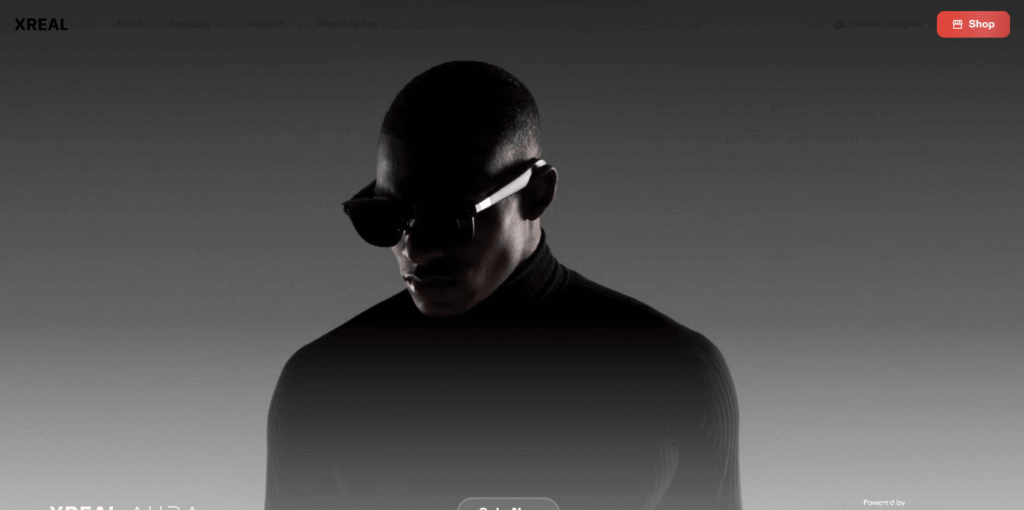
XREAL AURA is a wearable extended-reality device designed to bring digital screens and applications into the user’s field of view.
The product is different from traditional virtual reality headsets. Instead of completely covering your vision with a camera-generated view of the environment, AURA uses optical see-through technology. This allows users to see the real world directly while digital content appears in front of them.
Its software platform is Android XR, Google’s operating system developed for extended-reality devices. This gives the glasses access to familiar Google services, applications and spatial experiences.
Gemini is integrated as an AI assistant. Users can ask questions about what they are seeing, get help with displayed content and interact with applications through voice and other input methods.
The device is therefore positioned as more than a personal movie screen. It aims to become a portable workspace, entertainment system and AI companion.
XREAL AURA Specifications
| Feature | Specification |
|---|---|
| Product type | Wired spatial computing glasses |
| Operating system | Android XR |
| Glasses weight | Approximately 95g |
| Display | Sony Micro-OLED |
| Resolution | 1920 × 1200 per eye |
| Field of view | 70 degrees |
| Refresh rate | Up to 120Hz |
| Maximum brightness | 1,050 nits |
| Colour coverage | 100% sRGB |
| Glasses processor | XREAL X1S spatial coprocessor |
| Compute processor | Snapdragon Reality Elite platform |
| RAM | 12GB or 16GB |
| Storage | 256GB or 512GB |
| Wireless | Wi-Fi 6/6E, Bluetooth 5.3 |
| AI assistant | Google Gemini |
| Audio | Bose-tuned sound |
| Tracking | 6DoF and hand tracking |
The compute puck also includes a 4,455mAh battery, USB-C connections and support for compatible Bluetooth keyboards, mice and game controllers.
Design and Comfort: Are They Really Like Normal Glasses?
One of the most interesting aspects of XREAL AURA is its glasses-style design.
The glasses weigh around 95 grams, which is relatively light compared with conventional mixed-reality headsets. However, they are heavier than ordinary eyewear and some simpler smart glasses.
The system also requires a separate compute puck connected through a cable. This puck contains the main processing hardware and battery, so users must carry it while using the glasses.
That design has an advantage: moving the heavier computing components away from the frames can help keep the glasses themselves more manageable. The disadvantage is that the complete system is not as self-contained as wireless smart glasses.
XREAL offers medium and large fit options based on interpupillary distance, with prescription lens inserts supported.
The company also includes adjustable nose pads to help users find a comfortable fit.
Display Quality: The Biggest Reason to Consider AURA
The display system is one of the strongest parts of the product.
XREAL AURA uses Sony Micro-OLED panels with a resolution of 1920 × 1200 pixels per eye. The displays support up to 120Hz and have a 70-degree field of view.
This combination is intended to provide a large virtual viewing area for entertainment, gaming and productivity.
The optical see-through design is particularly important. Digital windows appear in the user’s surroundings without completely replacing direct vision of the environment.
AURA also includes electrochromic dimming with five transparency levels. Users can adjust how much outside light enters through the lenses, depending on whether they want a more immersive viewing experience or greater awareness of their surroundings.
The maximum advertised brightness is 1,050 nits. Actual perceived image quality will still depend on ambient lighting, fit, optical alignment and the content being displayed.
Android XR and Gemini AI: What Makes It Different?
Android XR is arguably the most important software feature of XREAL AURA.
Instead of depending on a limited collection of proprietary applications, the device provides access to a broader Android application ecosystem through Google Play.
The company highlights familiar applications such as YouTube, Google Maps, Chrome and Google Photos, alongside more than 150 applications designed specifically for XR experiences.
Gemini adds another layer of functionality.
Users can ask questions about the environment or displayed content, request help while using applications and interact with the system through natural conversation.
For example, someone watching a video could ask Gemini to explain something on the screen. A traveller could use Google Maps and ask questions about a destination.
These capabilities make AURA more interesting than a conventional wearable display. However, the usefulness of AI will depend on software quality, internet access, permissions and regional availability.
Entertainment and Gaming
XREAL AURA is designed to create a private entertainment screen that can travel with the user.
It supports applications such as YouTube and Google TV, allowing users to watch videos on a large virtual display without carrying a physical monitor.
The spatial interface also allows users to arrange digital windows around their environment.
Gaming is another major use case. Android games can run through the platform, while compatible computers, handheld consoles and other devices can connect through USB-C DisplayPort input.
The glasses also support XR experiences designed around spatial interaction and hand tracking.
For people who travel frequently, this could be useful for watching films, playing games or enjoying a larger display in a hotel room or on a journey.
However, the experience depends on carrying the compute puck, cables and any additional controllers needed.
Productivity: Can XREAL AURA Replace Multiple Monitors?
One of the more ambitious promises is the ability to create a portable multi-screen workspace.
XREAL says users can open up to five virtual screens and arrange them around their field of view.
This could be useful for people who want to work with a browser, documents, communication tools and other applications simultaneously.
AURA also supports wired laptop mirroring. A compatible laptop can connect through USB-C with DisplayPort support, allowing its screen to appear as a movable virtual window.
This is potentially valuable for remote workers, frequent travellers and people who want a private screen in public spaces.
However, virtual displays do not automatically provide the same comfort or productivity as physical monitors. Text readability, eye comfort, fit and the ability to work for extended periods will determine whether the system is genuinely useful.
XREAL AURA Price and Availability
The announced configurations are:
| Configuration | Standard price | Promotional price |
|---|---|---|
| 12GB RAM + 256GB | $1,279 | $1,099 |
| 16GB RAM + 512GB | $1,499 | $1,299 |
The promotional prices are advertised through December 2026.
Orders opened on October 28 in the United States, Canada and South Korea. Japan orders were scheduled to open on November 2. The company says additional markets are expected to follow in 2027.
India is not among the confirmed launch markets in the current announcement. Indian buyers should therefore check official regional availability, warranty coverage, import charges and service arrangements before attempting to purchase through an international seller.
Pros and Cons of XREAL AURA
Pros
- High-resolution Sony Micro-OLED displays.
- 120Hz refresh-rate support.
- Android XR and Google Play application ecosystem.
- Integrated Gemini AI assistance.
- Optical see-through design.
- Up to five virtual application windows.
- Laptop and compatible gaming-device connectivity.
- Prescription lens insert support.
Cons
- Expensive compared with conventional smart glasses.
- Requires a separate compute puck.
- Wired connection reduces freedom of movement.
- Complete system is less convenient than ordinary eyewear.
- Long-session comfort and productivity need real-world evaluation.
- Availability is initially limited to selected countries.
Is XREAL AURA Legit?
Yes. XREAL AURA is an officially announced product developed by XREAL in collaboration with Google and Qualcomm. Google has published a launch announcement, and XREAL provides official specifications and ordering information.
It is not an unknown product or an unverified online gadget listing.
However, official specifications and promotional demonstrations should not be confused with independent long-term testing. Battery endurance, comfort during extended use, software stability and real-world productivity performance are important factors that buyers should evaluate through detailed reviews.
Final Verdict: Should You Buy XREAL AURA?
XREAL AURA represents a significant development in wearable computing. Instead of focusing only on notifications or hands-free photography, it aims to bring a complete Android XR environment into a glasses-style device.
Its high-resolution Micro-OLED displays, Gemini integration, spatial applications and multi-window productivity features make it an interesting option for technology enthusiasts, frequent travellers and people who want a portable virtual workspace.
But the price is difficult to ignore. At $1,099 even during the promotional period, it is a substantial investment. The separate compute puck and wired connection also mean that AURA does not deliver the completely wireless experience some buyers may expect from smart glasses.
Our verdict: XREAL AURA is one of the more ambitious spatial computing products announced in 2026. It looks promising for entertainment, productivity and immersive applications, but buyers should wait for extensive independent testing if comfort, battery life and everyday usability are their main priorities. It is worth considering for early adopters, but it is not yet an essential purchase for ordinary smartphone users.
Frequently Asked Questions
1. What is XREAL AURA?
XREAL AURA is a pair of spatial computing glasses powered by Android XR, designed for entertainment, productivity, gaming and AI-assisted experiences.
2. How much does XREAL AURA cost?
The standard prices start at $1,279 for the 12GB/256GB model and $1,499 for the 16GB/512GB model. Promotional prices are advertised through December 2026.
3. Does XREAL AURA use Android XR?
Yes. Android XR is its operating system and provides access to Google services and compatible applications.
4. Does XREAL AURA support Gemini?
Yes. Gemini is integrated as an AI assistant that can help users interact with applications and understand displayed or surrounding content.
5. What is the resolution of XREAL AURA?
It uses Sony Micro-OLED displays with 1920 × 1200 resolution per eye.
6. Does XREAL AURA support 120Hz?
Yes. Its displays support refresh rates up to 120Hz.
7. Is XREAL AURA wireless?
No. The glasses connect to a separate compute puck through a cable. The puck handles the main processing and battery functions.
8. Can XREAL AURA replace a laptop?
Not completely. It can provide a virtual workspace and mirror a compatible laptop display, but it is not a full replacement for every computer workflow.
9. Can I play games on XREAL AURA?
Yes. It supports compatible Android games, XR experiences and external gaming devices through supported connections.
10. Does XREAL AURA support prescription lenses?
Yes. It includes an optical insert frame for compatible prescription lenses.
11. Is XREAL AURA available in India?
India is not listed among the initial confirmed launch markets. Additional regional availability is expected to expand in 2027, according to the company.
12. Is XREAL AURA worth buying?
It may be worthwhile for early adopters who want a portable spatial computer. Buyers seeking simple notifications, music or casual smart-glasses features may find it unnecessarily expensive.

Nikhil Sharma is the author and researcher behind Review Trails, where he shares shopping website reviews, product insights, and scam or legit website analysis. He focuses on providing honest, easy-to-understand information that helps readers make safer and smarter online purchasing decisions.