
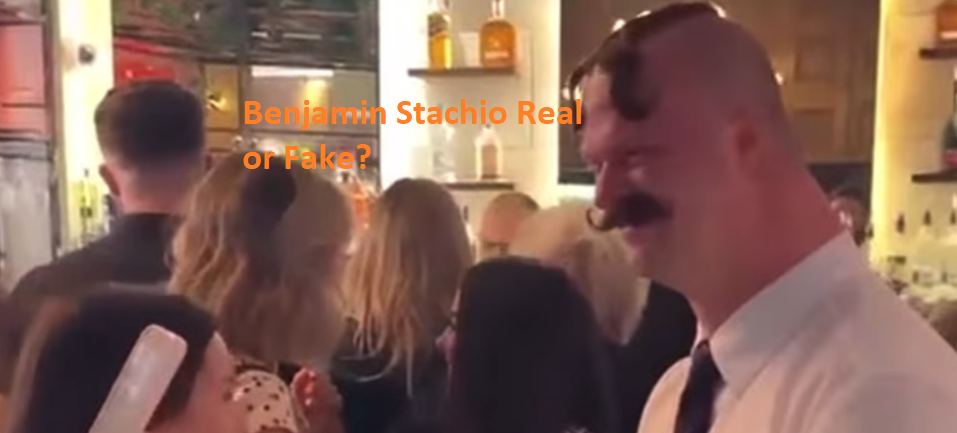
Is Benjamin Stachio real or fake? Benjamin Stachio appears to be an AI-generated fictional character, not a real person documenting his life online. The bizarre triple-mustache man recently went viral on Instagram after videos showed him dancing in a crowded bar, but the exaggerated anatomy, shifting facial features, unusual background movement and lack of a verifiable real-world identity strongly point toward AI-generated video.
A September 30, 2026 report from Dexerto identified Benjamin Stachio as an apparent AI character and noted that his Instagram account had gained more than 60,000 followers within days.
However, it is worth making one distinction: there may be a real person or creator operating the account behind the character. What appears to be fictional is the man depicted in the videos—not necessarily the person who created or manages the account.
Quick Answer: Is Benjamin Stachio Real or Fake?
Benjamin Stachio is most likely AI-generated.
The viral character appeared on Instagram only recently, with visible posts dating back to September 27, 2026. His videos show extremely unusual body proportions, including a huge neck and shoulders compared with his head, while his face and mustache appear to change between frames.
Other clues include:
- Unnatural body proportions
- Facial features that appear to morph
- Strange-looking hands and anatomy
- Unusual camera movement
- Background people moving in an artificial-looking way
- Speech and background audio that are difficult to understand
- No established biography or verifiable real-world history
- A social-media account that appeared suddenly and went viral extremely quickly
These characteristics are consistent with AI-generated video.
Verdict: Benjamin Stachio appears to be an AI-generated character.
Who Is Benjamin Stachio?
Benjamin Stachio is the name attached to a recently viral social-media character featuring an unusually muscular-looking man with multiple prominent mustaches.
The character became popular through short videos showing him apparently participating in ordinary social situations, particularly dancing in a crowded bar.
At first glance, the footage looks like an eccentric real person was filmed at a nightclub.
But closer inspection reveals several visual inconsistencies.
The most recognizable feature is the character’s exaggerated facial hair. His body also appears unusually shaped, with a disproportionately large neck and shoulders.
According to Dexerto, the Instagram account using the name @benjamin_stachio had accumulated roughly 62,500 followers when it was reported on September 30, 2026. The account’s visible posts reportedly began only a few days earlier.
That extremely rapid growth is part of what made the character a viral curiosity.
Why Does Benjamin Stachio Look Fake?
The biggest clue is his anatomy.
In the viral videos, Benjamin’s neck and shoulders appear much larger than would normally be expected relative to his head.
His face also appears to change shape during movement.
These are classic problems that can appear in generative AI video: individual frames may look convincing, but maintaining consistent anatomy from one frame to another is much harder.
Viewers have noticed that:
- The chin appears to move or change
- The mustache does not always behave consistently
- The neck seems unusually thick
- His head-to-body proportions look strange
- People in the background appear somewhat unnatural
- Camera movement does not always match the apparent physical environment
Dexerto reported that viewers quickly identified these irregularities after the clip went viral.
Is Benjamin Stachio a Real Person?
There is currently no credible evidence establishing Benjamin Stachio as a real person with the biography portrayed by the account.
That is different from saying that nobody named Benjamin Stachio exists anywhere.
The question is whether the bizarre man shown in the viral Instagram videos is a genuine human being.
Current evidence points toward no.
The account appeared suddenly, its content is highly surreal, and there is no established history connecting the character to a conventional real-world identity.
Dexerto specifically described the account as appearing to belong to an AI-generated character rather than a real person documenting his nightlife.
What Is the Evidence That Benjamin Stachio Is AI?
There is no single public laboratory report proving the videos were generated by a particular AI model.
Instead, the conclusion comes from a combination of clues.
1. Impossible-Looking Anatomy
The character’s proportions are one of the strongest clues.
His neck and shoulders appear disproportionately large, while his head and facial structure behave inconsistently.
AI video generators can create convincing human figures, but maintaining anatomically consistent bodies during complicated movement remains difficult.
2. Facial Morphing
Benjamin’s face appears to change subtly during the footage.
His mustache and chin can look different from one moment to the next.
A real person’s facial hair obviously moves with their face, but it does not normally reshape itself from frame to frame.
3. Strange Background Movement
The people behind Benjamin also contribute to the AI impression.
In the viral nightclub footage, background figures move in ways that can look overly smooth or disconnected from the environment.
This is important because AI-generated videos often struggle not only with the main subject but also with maintaining consistency among secondary characters.
4. Unusual Audio
The audio in the viral video is another curiosity.
Dexerto reported that the song contains warped vocals and lyrics that do not appear to form a clearly recognizable language. The publication suggested the audio may have been generated along with the video, although that part remains less certain than the visual evidence.
Therefore, it is better to say the audio may also be AI-generated, rather than presenting that as conclusively proven.
Did Benjamin Stachio Really Dance in a Bar?
There is no reliable evidence that the depicted event happened as an ordinary real-life recording.
The viral clip shows Benjamin dancing in a crowded bar while apparently singing along to music.
But the physical inconsistencies in the character and surrounding environment make the footage appear synthetic.
The clip was also reposted on X, where it accumulated more than a million views, helping drive the character beyond Instagram.
So while the video exists, that does not mean the event depicted in it actually happened.
This distinction is important when fact-checking AI content.
A video can be real as a digital file while showing an entirely fictional event.
Who Created Benjamin Stachio?
As of the latest reporting, the creator behind Benjamin Stachio has not publicly established a verified identity.
The Instagram account itself does not provide a detailed biography explaining who Benjamin is or how the videos were produced.
That leaves an important unanswered question:
Who is operating the account?
The character may be an intentionally created AI persona designed specifically for social-media virality.
That would make Benjamin Stachio similar to a fictional digital influencer rather than a conventional human influencer.
The fact that the character’s account gained tens of thousands of followers almost immediately suggests that the bizarre appearance was deliberately designed to attract attention.
Is Benjamin Stachio Part of a Larger AI Character Trend?
Yes.
Benjamin Stachio appears during a growing trend of deliberately fictional AI personalities being presented through social-media accounts.
These characters can be designed with exaggerated physical features, strange personalities or surreal situations.
Instead of attempting to make AI content completely indistinguishable from reality, creators sometimes make the artificial nature part of the entertainment.
Dexerto compared Benjamin’s emergence with other viral AI characters such as Jean Phil, Archibald Brown and Derek Mercer.
The formula is relatively simple:
- Create a visually distinctive character.
- Generate short videos.
- Give the character a recognizable personality.
- Post frequently.
- Encourage viewers to debate whether the person is real.
- Let the mystery generate engagement.
The “Is this person real?” question can itself become part of the viral marketing effect.
Why Did Benjamin Stachio Become Viral So Quickly?
The character has several characteristics that make social-media users stop scrolling.
His appearance is unusual
The enormous neck, exaggerated shoulders and distinctive mustache immediately make the character recognizable.
The videos look almost real
The footage is not presented as an obvious cartoon.
It resembles ordinary smartphone footage from a bar or nightclub, which creates uncertainty.
Viewers began debating whether he was human
Once users started asking whether the character was AI, the debate generated even more engagement.
The mystery became the content
People weren’t simply watching a dancing man.
They were watching a dancing man while trying to figure out whether he existed.
That is a powerful viral mechanism.
Is Benjamin Stachio a Deepfake?
It is safer to describe Benjamin Stachio as an AI-generated character rather than automatically calling him a deepfake.
“Deepfake” generally refers to synthetic media that manipulates or replaces the likeness of an existing real person.
Benjamin Stachio appears to be something slightly different: a fictional or synthetic character created to exist as an online personality.
There is currently no strong evidence that Benjamin Stachio is simply a deepfake of a particular real-world celebrity.
Therefore:
AI-generated character = appropriate description.
Deepfake of a known person = not established.
Is There a Real Person Behind Benjamin Stachio?
Possibly.
This distinction is easy to miss.
An AI-generated character still requires a creator, account owner or production process.
The person operating the Instagram account could be completely real.
They may have:
- Generated the character using AI
- Edited the videos
- Added music
- Written captions
- Managed the Instagram profile
- Responded to comments
So saying “Benjamin Stachio is AI” does not necessarily mean that the account owner is AI.
It means the person portrayed by the viral videos appears to be synthetic.
What Does Benjamin Stachio’s Instagram Account Show?
According to reporting published September 30, 2026, the account @benjamin_stachio had approximately 62,500 followers and followed no accounts at the time of the report.
The visible posts reportedly started around September 27.
Captions included phrases such as “Clearing my head,” “Dancing with friends,” and “About last night.”
One dancing video reportedly accumulated more than 640,000 likes and around 59,000 comments.
That is an extraordinary amount of engagement for an account that had appeared only days earlier.
The sudden growth itself does not prove AI generation, but it helps explain why the character became a viral topic so quickly.
Is Benjamin Stachio Connected to Cryptocurrency?
This is an important distinction because a cryptocurrency token using the STACHIO name has appeared on Solana trading platforms.
Public blockchain-tracking pages currently list tokens using the Benjamin Stachio/STACHIO name.
However, the existence of a token does not by itself establish that the Instagram character’s creator officially launched or endorses it.
Dexerto reported that the Benjamin Stachio Instagram profile did not have an official cryptocurrency link or token promotion at the time of its report.
This is particularly important because viral internet characters can quickly attract unofficial cryptocurrency projects.
Anyone encountering a “Benjamin Stachio coin” should independently verify whether it is officially connected to the character before treating it as an endorsed project.
Is Benjamin Stachio a Scam?
The word “scam” is not the best description based on the available evidence.
The character appears to be an AI-generated viral persona, but that does not automatically mean the account itself is fraudulent.
There is a difference between:
AI-generated entertainment
and
fraudulent activity.
If the account openly functions as an internet character, there is nothing inherently fraudulent about creating a fictional AI personality.
The situation becomes different if someone uses the character to impersonate a real person, collect money deceptively, promote fraudulent investments or obtain personal information.
No such conclusion should be drawn simply from the fact that Benjamin Stachio appears to be AI-generated.
Benjamin Stachio Real or Fake: Fact-Check Table
| Question | Finding |
|---|---|
| Is Benjamin Stachio a real person? | Apparently not |
| Is Benjamin Stachio AI-generated? | Strongly indicated |
| Is the viral Instagram character fictional? | Appears so |
| Is the dancing video genuine footage of a real man? | Very unlikely based on current evidence |
| Is there a verified biography for him? | No |
| Did the account suddenly go viral? | Yes |
| Are the unusual body proportions a clue? | Yes |
| Is the background footage suspicious? | Yes |
| Is the audio definitely AI-generated? | Not conclusively established |
| Is the person behind the account necessarily AI? | No |
| Is every STACHIO cryptocurrency project official? | Not established |
Benjamin Stachio Real or Fake: Final Verdict
Benjamin Stachio appears to be fake in the sense that the viral man is an AI-generated fictional character rather than a normal real-life influencer.
The strongest evidence is the combination of impossible-looking anatomy, shifting facial characteristics, unusual background movement and the account’s sudden appearance and rapid growth.
Dexerto’s September 30, 2026 reporting specifically identified the viral triple-mustache character as an AI persona and documented the visual inconsistencies that led viewers to that conclusion.
There is, however, an important caveat.
The existence of an AI character does not mean there is no real human creator behind the account.
Someone almost certainly operates the social-media profile and produces or commissions the content. What appears fictional is the character shown in the videos.
So the simplest answer is:
Benjamin Stachio is not a real-life man as portrayed online. He appears to be an AI-generated character created for viral social media content.
Frequently Asked Questions
Is Benjamin Stachio real or fake?
Benjamin Stachio appears to be AI-generated rather than a real person. Current reporting identifies him as an AI character.
Is Benjamin Stachio a real human?
There is currently no reliable evidence establishing the viral character as a real human being with the life portrayed in the videos.
Why does Benjamin Stachio look so strange?
His exaggerated neck, shoulders, facial proportions and shifting features are among the clues suggesting that the footage was generated or heavily manipulated using AI.
Is Benjamin Stachio CGI?
The available evidence points toward generative AI or similar synthetic-media technology, although the exact software used to create the videos has not been publicly confirmed.
Who created Benjamin Stachio?
The identity of the person or team behind the character has not been reliably established in the reporting currently available.
Is Benjamin Stachio’s Instagram account real?
The Instagram account itself is real in the sense that it exists and has posted the viral videos. The character appearing in those videos appears to be fictional/AI-generated.
Is Benjamin Stachio a deepfake?
There is no strong evidence that he is a deepfake of a specific real person. “AI-generated character” is the more accurate description based on current information.
Is the Benjamin Stachio cryptocurrency official?
A cryptocurrency using the STACHIO name exists on Solana-related trading platforms, but the existence of such a token does not establish official endorsement by the Instagram account.
When did Benjamin Stachio go viral?
The account’s visible posts reportedly began around September 27, 2026, with the character attracting tens of thousands of followers within only a few days.

Nikhil Sharma is the author and researcher behind Review Trails, where he shares shopping website reviews, product insights, and scam or legit website analysis. He focuses on providing honest, easy-to-understand information that helps readers make safer and smarter online purchasing decisions.