
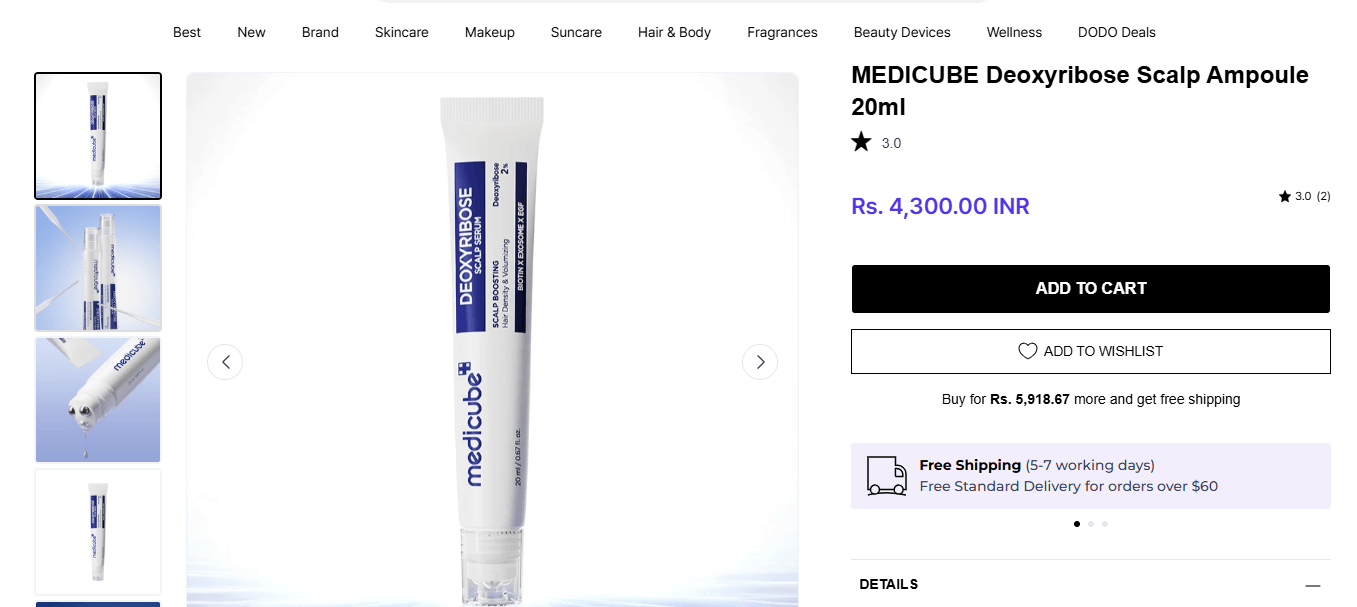
Deoxyribose scalp serums have become a popular hair-care trend because they are built around 2-deoxy-D-ribose (2dDR), a sugar molecule that has been investigated for its possible connection with hair growth and blood-vessel formation.
The interest is understandable because a 2024 scientific study found promising hair-regrowth effects from a 2-deoxy-D-ribose gel in a mouse model of androgenic alopecia. However, that study was performed on mice, not humans, and the researchers themselves said that the mechanism still requires further investigation.
That distinction is important when looking at today’s commercial Deoxyribose Scalp Serums. A promising research ingredient does not automatically mean that every serum containing it will regrow human hair.
So, is Deoxyribose Scalp Serum worth trying? Let’s look at the product claims, ingredients, reviews, science, and limitations.
Don’t Miss: EPAIS Hair Serum Review
What Is Deoxyribose Scalp Serum?
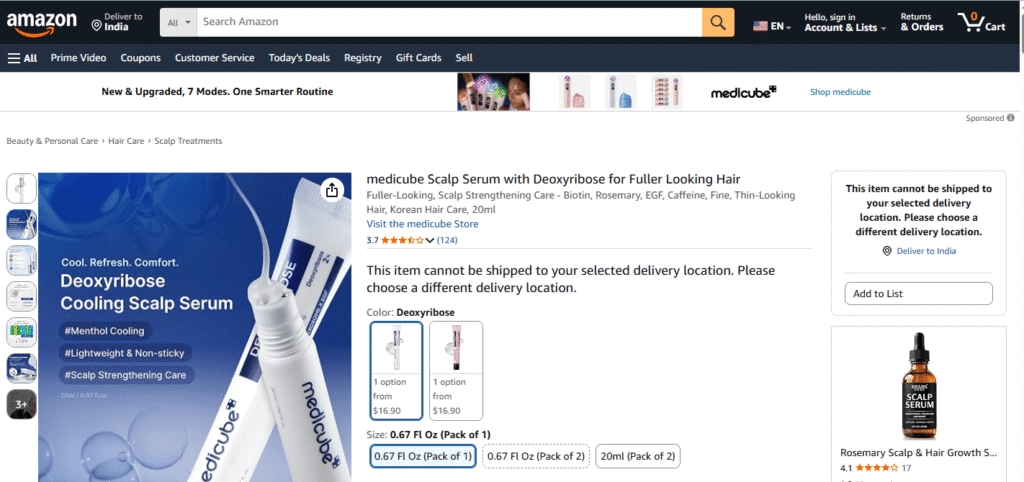
Deoxyribose Scalp Serum is a topical scalp-care product designed to be applied directly to areas where the hair appears thin or the scalp needs additional care.
One well-known version is the Medicube Deoxyribose Scalp Serum, which is sold as a 20 mL scalp serum for fuller-looking hair and scalp-strengthening care. Product listings describe ingredients and concepts including deoxyribose, rosemary, EGF, caffeine, peptides and other hair/scalp-care components.
The product is generally positioned as a cosmetic scalp-care step rather than something that should automatically be considered equivalent to a medical hair-loss treatment.
Other stores also sell products under the generic name “Deoxyribose Scalp Serum,” sometimes in different sizes and with different ingredient combinations. For example, some current listings describe 2% deoxyribose formulas and three-ball roller applicators.
Because of this, buyers should check the brand, ingredient list, size and seller before assuming that two products with the same name are identical.
Why Is Deoxyribose Being Used for Hair Growth?
The main reason for the current interest is scientific research involving 2-deoxy-D-ribose.
A 2024 study published in Frontiers in Pharmacology investigated a 2dDR-containing gel in a mouse model of androgenic alopecia. The researchers compared the treatment with minoxidil and observed improvements in several hair-growth measurements, including hair length, follicle density, follicle diameter and the anagen/telogen ratio.
The researchers proposed that 2dDR might influence blood-vessel formation and potentially increase the blood supply around hair follicles. Their work suggested that 2dDR could stimulate hair growth in that animal model.
This is the part of the story that has attracted so much attention.
But it is equally important to understand what the study did not prove.
It did not prove that an over-the-counter deoxyribose serum will regrow hair in humans. It also did not establish that every commercial product containing deoxyribose has the same concentration, delivery system or effectiveness as the research formulation.
What Does the Research Actually Show?
The 2024 study used C57BL/6 mice with an androgen-related hair-loss model. Researchers applied a specially prepared 2dDR-containing alginate gel for 20 days and compared the results with other treatment groups, including minoxidil.
The findings were encouraging.
The 2dDR treatment was associated with changes in hair follicle development, hair length, hair-shaft diameter, follicle density and blood-vessel measurements. The researchers reported effects that were broadly comparable to their minoxidil group in this particular animal model.
However, the authors also stated that the mechanism of action still needs further investigation.
That means the study is best described as early scientific evidence, rather than final proof that 2dDR is an established human hair-growth treatment.
This difference matters because many ingredients look promising in laboratory or animal research but do not necessarily produce the same results when used by people.
What Ingredients Are Found in Deoxyribose Scalp Serums?
The exact formula depends on the brand.
For the Medicube version, available product listings associate the serum with deoxyribose alongside ingredients such as rosemary, EGF, caffeine and peptides.
Other commercial Deoxyribose Scalp Serums can have substantially different formulas. Some sellers specifically advertise 2% deoxyribose, while others emphasize combinations involving rosemary, caffeine and other scalp-care ingredients.
Therefore, it would be misleading to assume that every product called “Deoxyribose Scalp Serum” contains the same ingredients or the same amount of deoxyribose.
Deoxyribose
This is the ingredient responsible for most of the current attention.
The scientific interest comes from the 2024 animal research discussed above. The research is promising, but human evidence remains much less established.
Caffeine
Caffeine is commonly included in cosmetic scalp products marketed around hair and scalp care. In deoxyribose products, it is generally presented as part of the overall formula rather than as proof that the product will necessarily regrow hair.
Rosemary
Rosemary appears in some commercial versions of the serum, including listings for Medicube’s product.
Peptides and Other Scalp-Care Ingredients
Some versions also use peptides and other cosmetic ingredients intended to support the appearance and condition of the scalp and hair.
The important point is that the finished formula matters more than the presence of one trendy ingredient.
How Is the Serum Applied?
Products using a roller-style applicator are designed to make targeted scalp application easier.
One product listing describes applying the serum directly to the scalp with the massage applicator and gently massaging until absorbed. It can be used on a clean, towel-dried or dry scalp depending on the product instructions.
Some generic Deoxyribose Scalp Serum products advertise three-ball applicators and recommend rolling the product over thinning areas before massaging it into the scalp.
This type of application can be convenient because the serum can be placed directly where the user wants it instead of spreading it through the entire hair length.
However, application instructions can vary between brands, so buyers should follow the instructions on their specific bottle.
Deoxyribose Scalp Serum Customer Reviews
Customer feedback is mixed and varies considerably depending on the particular brand and seller.
For the Medicube version, one current TikTok Shop listing shows a 4.3/5 rating from 2,265 global reviews. The published reviews include both positive experiences and complaints.
Some customers report liking the product and its scalp-care experience. Others say they did not see noticeable hair growth.
One verified customer reported that the product dried out their hair and that they had not seen hair growth even after using multiple tubes.
That kind of feedback is useful because it shows why a single testimonial should not be treated as proof that the serum will work for everyone.
Another retailer currently lists only four reviews, all five-star, showing how dramatically review results can change depending on the retailer and the size of the review sample.
Positive Things Customers Mention
Across available listings, positive comments tend to focus on:
- Easy targeted application
- Cooling or refreshing scalp sensation
- Lightweight texture
- Convenient roller applicator
- Scalp feeling more comfortable
- Hair appearing fuller to some users
- Easy addition to a daily routine
For example, TikTok Shop reviews include customers who describe the serum as pleasant on the scalp and smooth to apply.
These comments are useful for understanding the user experience, but they are not controlled clinical evidence of hair regrowth.
Negative Reviews and Complaints
There are also negative experiences.
Some users report that they did not see noticeable hair growth. One Medicube reviewer said the product dried out their hair and that they had not observed improvement after continued use.
Another independent review compilation reports complaints involving limited visible fullness improvement, strong tingling for some users and the relatively small amount of product supplied. It also gives the tracked product a mixed rating rather than presenting universally positive feedback.
This is important because hair growth is a slow process, and early cosmetic changes can be difficult to distinguish from genuine new growth.
Does Deoxyribose Scalp Serum Really Work?
This is the biggest question.
The most accurate answer is:
There is promising scientific evidence for 2-deoxy-D-ribose in an animal model, but there is not enough evidence to say that commercial Deoxyribose Scalp Serums are proven human hair-regrowth treatments.
The 2024 study is real and interesting. The researchers observed hair-regrowth effects in mice and proposed a connection with angiogenesis and follicle stimulation.
But a mouse study cannot establish the same outcome in people.
There is also a second issue: commercial serums are not necessarily identical to the experimental gel used in the study.
The concentration, formulation, penetration, stability and application method can all influence what happens on human skin.
Therefore, claims such as “guaranteed hair regrowth,” “permanent bald-spot reversal,” or “works just like minoxidil” would go beyond what the available evidence can currently support.
Deoxyribose vs. Minoxidil
The 2024 animal study compared 2dDR with minoxidil and reported similar effects in that particular mouse model.
That does not mean that deoxyribose has been proven to be equivalent to minoxidil in humans.
Minoxidil has a much longer history of human clinical research and is an established treatment option for certain forms of hair loss. Deoxyribose is still a much newer research area.
So the two should not be treated as interchangeable simply because they produced comparable results in one animal study.
Is Deoxyribose Scalp Serum a Scam?
The existence of a commercial product and the existence of scientific research are two different questions.
The ingredient itself is not simply an invented marketing concept. There is genuine published research investigating 2-deoxy-D-ribose and hair growth.
At the same time, the research does not validate every product marketed as Deoxyribose Scalp Serum.
This category has also attracted many different sellers using similar product names, formulas, review counts and marketing language. A recent investigation noted that multiple online stores are selling similarly named deoxyribose products under different labels.
For that reason, buyers should evaluate the specific seller and specific product, rather than assuming that all Deoxyribose Scalp Serums are the same.
Pros and Cons
Pros
- Uses an ingredient connected to interesting early hair-growth research.
- The underlying 2dDR research has been published in a scientific journal.
- Roller-style applicators can make targeted scalp application convenient.
- Some users report a pleasant, cooling scalp experience.
- Lightweight formulas may be more convenient than heavy scalp oils.
- Several commercial versions combine deoxyribose with other scalp-care ingredients.
Cons
- The strongest published hair-growth evidence is currently from an animal study.
- Human evidence for commercial deoxyribose serums is still limited.
- Products sold under the same name may have different formulas.
- Some customers report no noticeable hair-growth improvement.
- Some versions can be relatively expensive for a small amount of serum.
- Positive customer reviews cannot establish that the serum caused new hair growth.
Who Might Consider Trying It?
A person who enjoys experimenting with newer cosmetic scalp-care products may find Deoxyribose Scalp Serum interesting, particularly because the ingredient has genuine early-stage scientific research behind it.
The product may also appeal to people who prefer targeted scalp application instead of heavy oils.
But expectations should remain realistic.
If someone has significant or rapidly progressing hair loss, patchy bald spots, scalp inflammation, or unexplained shedding, buying a cosmetic serum should not replace finding out what is causing the hair loss.
Who Should Be More Careful?
People with sensitive scalps should pay attention to the complete ingredient list of their particular product rather than relying only on the word “deoxyribose.”
Likewise, anyone expecting a proven medical hair-loss treatment should understand the evidence gap.
The most important question is not simply whether deoxyribose is scientifically interesting. It is whether the specific product being purchased has strong human evidence showing that its particular formula produces meaningful hair regrowth.
At present, that evidence is not established strongly enough to make that conclusion.
Final Verdict
Deoxyribose Scalp Serum is an interesting example of how early scientific research can quickly become a beauty trend.
The science behind 2-deoxy-D-ribose is real. A 2024 study found encouraging hair-regrowth effects in a mouse model and suggested that the ingredient may influence blood-vessel formation around hair follicles.
However, the study was not a human clinical trial, and the researchers noted that the mechanism requires further investigation.
That means the strongest conclusion right now is that deoxyribose is promising, but not yet proven as a human hair-regrowth ingredient.
Commercial products may still be useful as scalp-care products, and some customers clearly enjoy the texture, applicators and overall experience. But customer testimonials should be separated from scientific evidence, especially when the claim involves actual hair regrowth.
Bottom Line
If you are interested in trying a modern scalp serum built around a scientifically interesting ingredient, Deoxyribose Scalp Serum may be worth considering with realistic expectations.
If your main goal is guaranteed or medically established hair regrowth, the current evidence is not strong enough to treat deoxyribose serum as a proven replacement for established hair-loss treatments.
The most important thing is to check the exact brand, ingredient list, seller and reviews because “Deoxyribose Scalp Serum” is now being used for multiple products rather than one universally standardized formula.
In short: the science is promising, the product category is interesting, but the human evidence is still too early to call Deoxyribose Scalp Serum a proven hair-growth treatment.

Nikhil Sharma is the author and researcher behind Review Trails, where he shares shopping website reviews, product insights, and scam or legit website analysis. He focuses on providing honest, easy-to-understand information that helps readers make safer and smarter online purchasing decisions.