
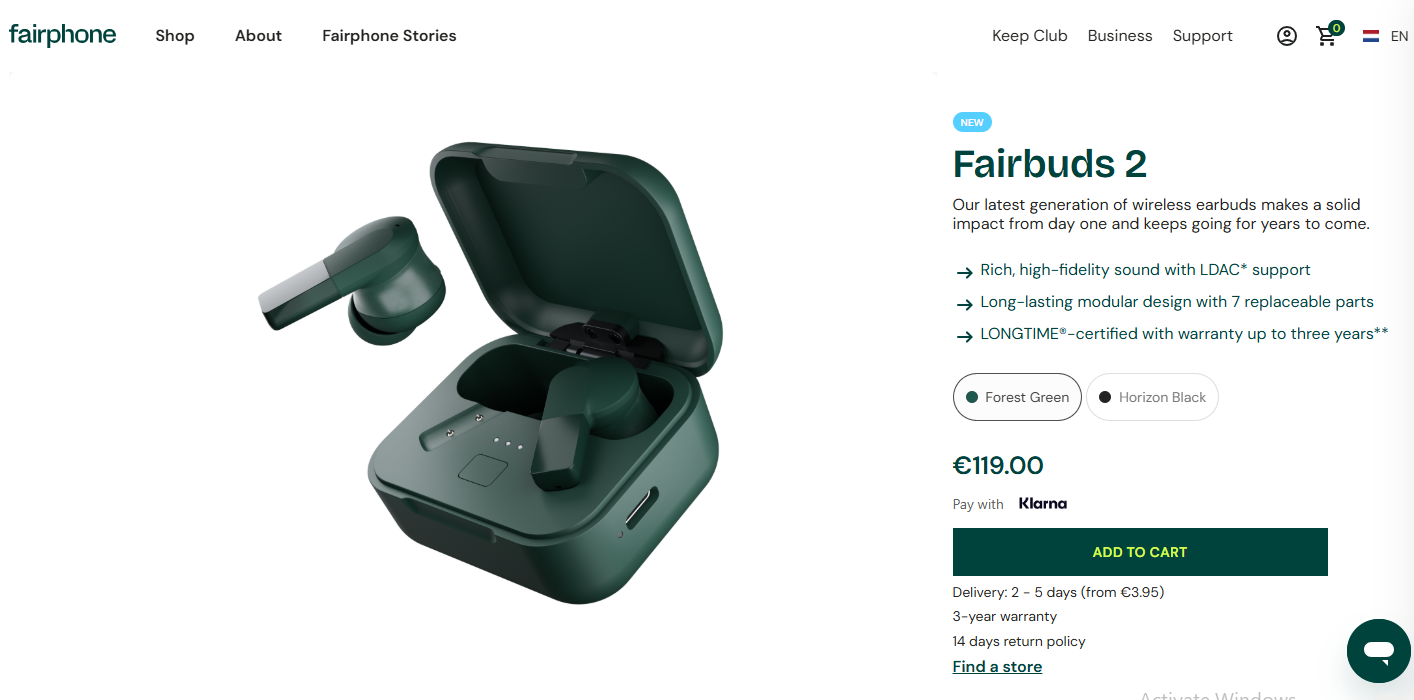
The Fairphone Fairbuds 2 take a different approach to the wireless earbud market. Instead of treating earbuds as disposable electronics, Fairphone has designed its latest model so that key components—including the batteries—can be replaced by users. The result is a pair of true wireless earbuds that combine active noise cancellation, modern Bluetooth connectivity and everyday convenience with a stronger focus on repairability.
But are the Fairbuds 2 worth buying for their sound quality and features alone, or does their appeal depend primarily on their sustainability credentials? Here is a closer look at the specifications, reported listening impressions, advantages, drawbacks and important things to consider before purchasing.
What Are the Fairphone Fairbuds 2?
The Fairbuds 2 are the second-generation version of Fairphone’s repair-focused wireless earbuds. They introduce updated dynamic drivers, support for the LDAC audio codec, Bluetooth 6.0, dual-device multipoint connectivity and hybrid active noise cancellation.
Their defining feature is the modular construction. Fairphone says users can replace up to seven parts, including the individual earbud batteries and the charging-case battery. This design aims to extend the product’s useful life and reduce the need to replace an entire set when one component fails.
The earbuds are available in Forest Green and Horizon Black, with a redesigned form that is smaller than the original model’s overall package. They are aimed at listeners who value long-term ownership as much as sound and convenience.
Fairbuds 2 Specifications at a Glance
| Feature | Details |
|---|---|
| Type | True wireless stereo earbuds |
| Drivers | 11 mm bio-cellulose dynamic drivers |
| Noise control | Hybrid active noise cancellation (ANC) |
| Bluetooth | Bluetooth 6.0 |
| Audio codec | LDAC support |
| Multipoint | Connect to two devices |
| Battery life | Up to 8 hours without ANC; 6 hours with ANC |
| Total playback | Up to 40 hours with charging case |
| Water and dust protection | IP54 |
| Charging | USB-C |
| Repairability | Up to seven user-replaceable parts |
| Colours | Forest Green and Horizon Black |
| Launch pricing | Around $119 in the US and €119 in Europe |
These are manufacturer specifications and advertised maximums, not guarantees of identical performance for every listener. Actual battery life depends on volume, codec, ANC use and other conditions.
Design and Build Quality
The Fairbuds 2 have a distinctive design that prioritises access to replaceable components. Their charging case and earbuds are more compact than the previous generation’s, according to Fairphone, although the earbuds may still look and feel chunkier than some minimalist alternatives.
The IP54 rating provides protection against dust and water splashes, making them suitable for many everyday situations, including commutes and light workouts. It does not mean they are waterproof or safe to submerge.
The most important design choice is the ability to open and repair the product. Fairphone says the batteries, case components, shells and individual earbuds can be replaced. This is a meaningful difference from many wireless earbuds, where battery degradation can make an otherwise functional product difficult or uneconomical to repair.
Fit remains personal. The included silicone ear tips offer different sizes, so finding the right seal is important for comfort, bass response and noise cancellation.
Sound Quality: Promising, but Not Class-Leading
Fairphone has equipped the Fairbuds 2 with 11 mm bio-cellulose dynamic drivers and says the updated tuning improves clarity and tonal balance compared with the earlier model.
Independent reviews suggest the sound is generally enjoyable for everyday listening, with clear enough vocals and a respectable overall presentation. However, the experience is not universally described as exceptional. Some reviewers have noted that bass can lack depth or definition in certain tracks, while the soundstage may feel less spacious than on stronger premium competitors.
The LDAC codec is a welcome addition for compatible devices. It can transmit higher-bitrate audio than standard Bluetooth codecs under suitable conditions, but it does not automatically guarantee better sound. Your phone must support LDAC, and the audible difference depends on the recording, settings and listening environment.
The companion app offers sound presets and a five-band equaliser, allowing listeners to adjust the presentation to their preferences.
Verdict on audio: The Fairbuds 2 appear capable of delivering satisfying everyday sound, but buyers whose top priority is class-leading audio should compare them with alternatives before deciding.
Active Noise Cancellation and Transparency Mode
Hybrid ANC helps reduce unwanted background noise, which can be useful on public transport, in offices and during travel. The Fairbuds 2 also include a transparency mode intended to let environmental sounds pass through when you need to remain aware of your surroundings.
Reviews suggest ANC is useful but not necessarily among the strongest systems available. Transparency performance and the naturalness of ambient sound have also received mixed feedback. These features should be viewed as practical conveniences rather than a guarantee of complete isolation or perfectly natural environmental audio.
For frequent commuters, the noise cancellation may be sufficient. For people who regularly travel in particularly loud environments, a direct comparison with leading ANC earbuds is sensible.
Battery Life and Charging
Battery life is competitive on paper. Fairphone advertises up to eight hours of playback per charge with ANC switched off, or up to six hours with ANC enabled. With recharges from the case, total playback is rated at up to 40 hours.
The case charges through USB-C. Wireless charging is not supported, so anyone who prefers to charge accessories on a Qi pad will need to use a cable.
The bigger advantage is not just the advertised runtime: the batteries are replaceable. As rechargeable cells naturally age, this can make the earbuds easier to maintain and may help avoid the cost and waste of buying an entirely new set.
Actual long-term battery performance remains something buyers should judge over time rather than infer from the launch specifications alone.
Repairability and Sustainability: The Main Selling Point
Many wireless earbuds have a built-in limitation: once their small batteries deteriorate, replacement can be difficult. Fairphone has tried to address that problem with a modular design and replaceable components.
The Fairbuds 2 are designed so users can replace more than just the ear tips. Fairphone identifies up to seven replaceable parts, including both earbud batteries, the charging-case battery and other structural or electronic components. The ability to replace an individual earbud can also be useful if one is lost or damaged.
Fairphone says the product uses fair and recycled materials and has a PFAS-free exterior. These are manufacturer-reported sustainability claims; they should not be mistaken for a complete independent assessment of the product’s entire environmental footprint.
Repairability also has practical limits. The long-term value depends on spare parts remaining available, replacement costs being reasonable and owners being willing to carry out the repair.
Even with those qualifications, the approach is valuable: extending the life of electronics is a practical way to reduce unnecessary replacements.
Connectivity, Calls and Everyday Use
Bluetooth 6.0 and dual multipoint allow the earbuds to connect to two devices, which is useful when switching between a laptop and a phone. The six-microphone system supports calls and noise management, while capacitive touch controls provide basic playback and listening-mode functions.
Call quality deserves particular attention. Some early reviews have reported inconsistent microphone performance in noisy surroundings, with background noise occasionally interfering with voice clarity. If you regularly take work calls outdoors or in busy places, this is an area worth testing during a return period.
The Fairbuds 2 cover the key modern wireless-earbud features, but they do not necessarily offer the most polished experience in every category. Their appeal is the combination of features and repairability rather than a clear lead in every technical metric.
Pros and Cons
Pros
- Replaceable batteries in both earbuds and the charging case.
- Up to seven user-replaceable components.
- LDAC support for compatible devices.
- Hybrid active noise cancellation and transparency mode.
- Dual-device multipoint connectivity.
- Up to 40 hours of advertised total playback.
- IP54 dust and splash resistance.
- A repair-oriented design that may extend useful product life.
Cons
- Sound quality may not match the strongest audio-focused competitors.
- ANC performance is useful but not necessarily class-leading.
- Microphone performance in noisy environments has received mixed feedback.
- No wireless charging.
- The earbud shape may feel bulky for some users.
- Long-term repair value depends on spare-part availability and cost.
Are the Fairphone Fairbuds 2 Worth Buying?
The Fairbuds 2 make the strongest case for themselves when repairability is a major buying criterion. Their replaceable batteries and modular components address a real weakness of many true wireless earbuds: the difficulty of keeping them useful as batteries and other parts age.
Their everyday feature set is also appealing. ANC, LDAC, multipoint connectivity, IP54 protection and a claimed 40-hour total battery life cover many of the needs of a typical listener. However, available reviews suggest that sound, transparency mode and call quality may not be best-in-class.
The launch price of around $119 in the US or €119 in Europe positions them as a mid-priced option in those markets. Local availability and pricing may differ, so buyers elsewhere should confirm the current price, shipping arrangements, warranty terms and replacement-part costs before ordering.
Final verdict: The Fairphone Fairbuds 2 are worth considering if you want wireless earbuds designed to be repaired rather than discarded. They combine useful modern features with a more responsible ownership model. If your main goal is the best possible noise cancellation, microphone quality or audio performance for your budget, compare them with competing models first.
Frequently Asked Questions
1. Can you replace the Fairbuds 2 batteries?
Yes. Fairphone says the batteries in the individual earbuds and the charging case are user-replaceable, along with several other components.
2. How long does the battery last?
Fairphone advertises up to eight hours per charge with ANC off and up to six hours with ANC on. Total playback with the charging case is rated at up to 40 hours. Actual results vary with use.
3. Do the Fairbuds 2 support active noise cancellation?
Yes. They feature hybrid ANC and a transparency mode. Independent impressions suggest the noise cancellation is useful, though not necessarily among the best available.
4. Do they support high-resolution Bluetooth audio?
They support LDAC, which can provide higher-bitrate Bluetooth audio when the source device supports the codec and the connection permits it.
5. Are the Fairbuds 2 waterproof?
No. Their IP54 rating indicates dust protection and resistance to water splashes, not protection against submersion.
6. Are they suitable for phone calls?
They support calls through a multi-microphone system, but reports of performance in noisy surroundings are mixed. People who depend on clear outdoor or professional calls should compare microphone performance before purchasing.
7. Who should buy the Fairbuds 2?
They are best suited to people who value repairability, replaceable batteries and a longer potential service life, while still wanting modern wireless-earbud features.
8. Are they better than conventional wireless earbuds?
That depends on your priorities. Their repairable design is a major advantage, but sound quality, ANC, fit and call performance should be compared against other models at a similar price.
This review is based on published specifications and available reporting, not a claim of personal hands-on testing. Features, prices and regional availability may change.
Also, Check: Glokore EyeRenew Pro Reviews

Nikhil Sharma is the author and researcher behind Review Trails, where he shares shopping website reviews, product insights, and scam or legit website analysis. He focuses on providing honest, easy-to-understand information that helps readers make safer and smarter online purchasing decisions.