
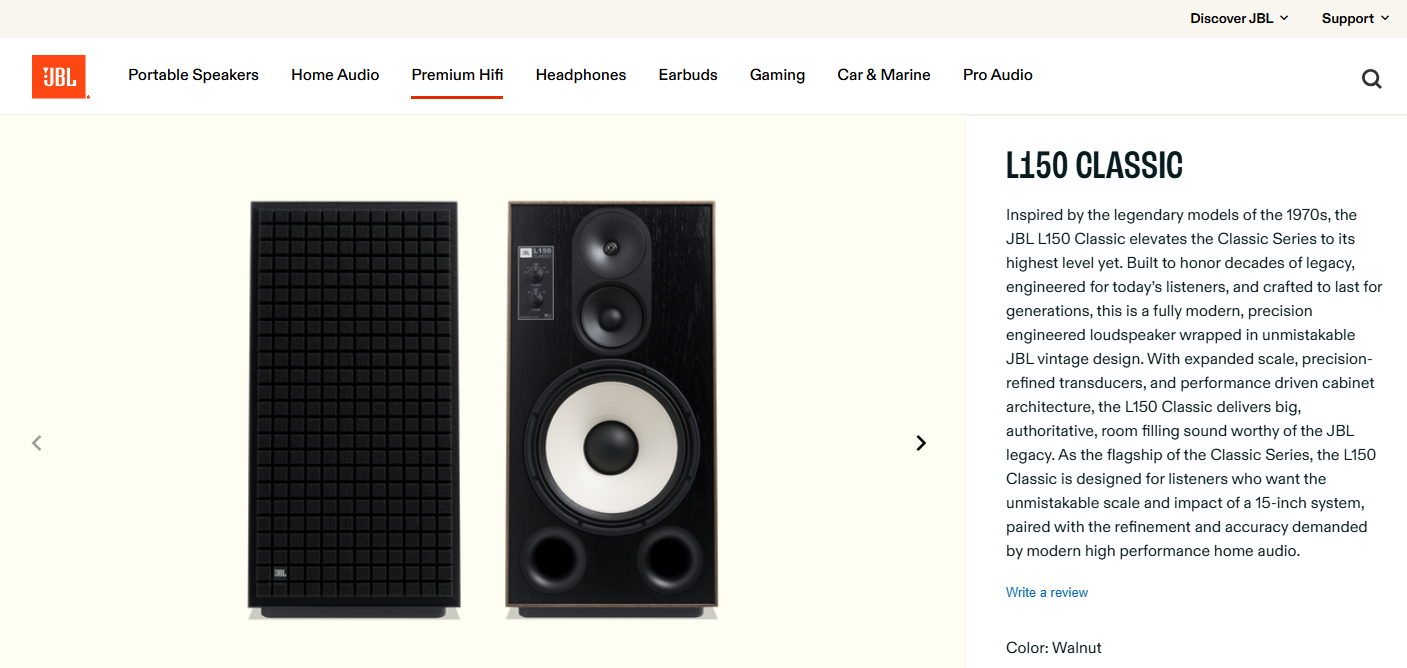
The JBL L150 Classic is a new, large-format floorstanding loudspeaker that combines JBL’s unmistakable 1970s-inspired styling with modern driver technology. Featuring a substantial 15-inch woofer, a dedicated midrange driver, and a titanium dome tweeter, it is designed for music enthusiasts who want powerful bass, room-filling sound, and a classic hi-fi appearance.
Announced in October 2026, the L150 Classic becomes the flagship of JBL’s Classic Series. Its impressive specifications and premium positioning make it an interesting addition to the high-end speaker market. But is it worth its expected $9,999-per-pair price?
This JBL L150 Classic review examines its design, specifications, expected sound characteristics, amplifier requirements, pricing, and availability.
What Is the JBL L150 Classic?
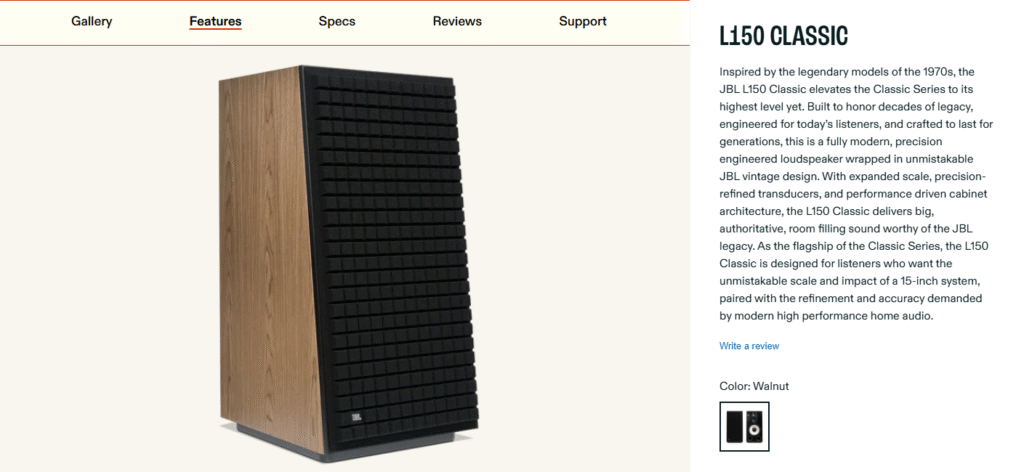
The JBL L150 Classic is a three-way passive floorstanding loudspeaker inspired by the company’s legendary large speakers from the 1970s. It expands the styling and engineering approach seen in the L100 Classic and L82 Classic into a considerably larger cabinet.
Unlike a wireless Bluetooth speaker, the L150 Classic is designed for a traditional home hi-fi system. It needs a separate amplifier or receiver and appropriate speaker connections.
JBL’s design combines:
- A large 15-inch bass driver.
- A dedicated 6.5-inch midrange driver.
- A 28mm titanium dome tweeter.
- A vented bass-reflex enclosure.
- Front-panel high- and low-frequency adjustment controls.
- Dual binding posts for bi-wiring or bi-amplification.
The speaker made its public debut at the 2026 Audio Video Show in Warsaw, Poland. JBL positions it as a modern flagship for listeners who appreciate large-format loudspeakers and traditional hi-fi styling.
JBL L150 Classic Design and Build Quality
The L150 Classic has a distinctive appearance that recalls JBL’s vintage loudspeakers. Its natural walnut veneer cabinet is paired with a black Quadrex foam grille, creating a retro look without relying on an entirely vintage design.
The grille attaches magnetically, allowing owners to display the drivers when desired. The cabinet also features an angled profile and sloped front baffle intended to direct sound toward the listening position.
This is a substantial speaker, not a compact living-room accessory.
Each cabinet measures:
- Height: 935mm (36.8 inches).
- Width: 470mm (18.5 inches).
- Depth: 540mm (21.2 inches).
- Weight: 52kg (114.6 pounds).
The size and weight have practical implications. Buyers should measure their listening room and plan for safe delivery and installation. Moving a pair will likely require two people.
JBL L150 Classic Sound Technology
1. 15-Inch Differential Drive Woofer
The most striking feature is the 15-inch (380mm) Pure Pulp Differential Drive woofer.
Its large cone area is intended to move substantial amounts of air, supporting deep bass and high-output listening. JBL specifies a low-frequency extension of 33Hz with the bass control at its standard setting.
With the low-frequency control raised by 2dB, the specified extension reaches 30.5Hz.
These specifications suggest that the L150 Classic is designed to deliver substantial bass without necessarily requiring a separate subwoofer for ordinary music listening. Actual bass response will depend on room dimensions, placement, and acoustics.
2. Dedicated 6.5-Inch Midrange Driver
The 6.5-inch polymer-coated Pure Pulp midrange driver handles the central portion of the audio spectrum.
A dedicated midrange driver allows the speaker to divide frequency responsibilities among three separate transducers. This design is intended to reproduce vocals and instruments with clarity while reducing the burden on the large bass driver.
3. 28mm Titanium Dome Tweeter
High frequencies are handled by a 28mm titanium dome tweeter combined with an acoustic lens and waveguide.
The waveguide helps control how sound is distributed into the listening space, while the acoustic lens forms part of JBL’s high-frequency design.
The specification suggests an emphasis on controlled treble reproduction and a broad soundstage, although independent listening tests will be needed to establish how the speaker actually performs.
4. Adjustable High- and Low-Frequency Controls
One useful feature is the pair of front-panel attenuation controls.
Listeners can adjust high- and low-frequency output to suit their room or personal preferences. This is particularly helpful with large speakers because room acoustics and placement can significantly influence perceived bass and treble.
The controls provide more flexibility than a speaker with a completely fixed tonal balance.
JBL L150 Classic Specifications
| Specification | Details |
|---|---|
| Speaker type | Three-way floorstanding |
| Woofer | 15-inch Pure Pulp Differential Drive |
| Midrange | 6.5-inch polymer-coated Pure Pulp |
| Tweeter | 28mm titanium dome |
| Frequency response | 33Hz–22.5kHz |
| Extended bass setting | 30.5Hz at +2dB |
| Sensitivity | 88dB (2.83V/1m) |
| Nominal impedance | 4 ohms |
| Recommended amplifier power | 25–250W RMS |
| Crossover frequencies | 310Hz and 1.8kHz |
| Enclosure | Vented bass-reflex |
| Connections | Dual gold-plated binding posts |
| Finish | Natural walnut veneer |
| Dimensions | 935 × 470 × 540mm |
| Weight | 52kg per speaker |
Specifications are based on JBL’s published product information.
Amplifier Compatibility and Connectivity
The JBL L150 Classic is a passive loudspeaker, so buyers will need a suitable external amplifier.
JBL recommends amplifier power between 25 and 250 watts RMS. Its nominal impedance is 4 ohms, meaning amplifier compatibility deserves attention.
Choose an amplifier that can operate comfortably into a 4-ohm load, particularly if you intend to listen at high volume. A quality amplifier with stable current delivery is more important than simply choosing the highest wattage rating.
The dual gold-plated binding posts support:
- Standard single-wire connections.
- Bi-wiring.
- Bi-amplification.
These options provide flexibility for enthusiasts building more elaborate stereo systems. However, bi-wiring and bi-amplification are optional rather than requirements for enjoying the speakers.
Expected Sound Quality: What Can Buyers Expect?
The L150 Classic’s driver configuration and published specifications suggest a speaker designed for scale, dynamics, and full-range music reproduction.
The 15-inch woofer should provide substantial low-frequency capability, while the dedicated midrange and titanium tweeter divide the work across the frequency spectrum.
Potential strengths include:
Powerful bass: The large woofer and bass-reflex cabinet are designed to deliver deep, authoritative low frequencies.
Room-filling presentation: The cabinet size and driver arrangement are intended for listeners who want a larger-scale stereo experience.
Adjustable tonal balance: Front-panel controls provide practical flexibility for different rooms.
Traditional hi-fi versatility: Passive connections make the speakers suitable for a range of stereo amplifiers and high-end systems.
There is an important limitation, however: the L150 Classic is newly announced, and the specifications are not a substitute for independent listening measurements or long-term reviews. It would be premature to describe its actual tonal balance, imaging, or distortion performance as proven.
JBL L150 Classic Price and Availability
JBL has announced a suggested US retail price of $9,999 per pair.
Production is scheduled to begin in December 2026, with regional availability expected during the first quarter of 2027. Exact release dates and prices outside the United States have not yet been confirmed.
The official JBL US product page lists the model but currently shows it as unavailable. Interested buyers should contact an authorized JBL retailer for updates rather than assume that an online listing means immediate stock is available.
For Indian buyers, the final local price may differ because of taxes, import costs, distribution, and retailer margins. No confirmed Indian retail price is available in the launch information.
Pros and Cons
Pros
- Large 15-inch Differential Drive woofer.
- Dedicated midrange and titanium dome tweeter.
- Vintage-inspired walnut and Quadrex grille design.
- Front-panel bass and treble adjustment.
- Bi-wiring and bi-amplification support.
- Published bass extension down to 30.5Hz with adjustment.
Cons
- Very high expected purchase price.
- Large and heavy cabinets require substantial space.
- Needs a separate, compatible amplifier.
- No independent long-term listening assessment yet.
- Regional pricing and availability remain unconfirmed.
Who Should Buy the JBL L150 Classic?
The L150 Classic is aimed at serious stereo enthusiasts who want large-format speakers with a distinctive vintage appearance and modern engineering.
It may appeal to:
- Owners of spacious listening rooms.
- Fans of JBL’s Classic Series.
- Audiophiles who enjoy powerful bass and dynamic music reproduction.
- Collectors interested in premium walnut-finished loudspeakers.
- Buyers building a high-end passive stereo system.
It is less suitable for small apartments, compact desktop setups, or buyers who want an all-in-one wireless speaker. Its size, amplifier requirements, and price make it a specialized purchase.
Final Verdict: Is the JBL L150 Classic Worth Buying?
The JBL L150 Classic is an ambitious addition to the Classic Series. Its 15-inch woofer, dedicated midrange driver, titanium dome tweeter, adjustable tonal controls, and walnut cabinet give it a compelling combination of traditional JBL styling and contemporary loudspeaker engineering.
The $9,999-per-pair price places it firmly in the premium hi-fi category. Buyers are paying for a large-format speaker design, substantial cabinet construction, and JBL’s flagship Classic Series positioning.
However, the product is too new for a definitive performance verdict. Independent listening tests, measurements, and comparisons with competing speakers will be important before making such a substantial investment.
Our verdict: The JBL L150 Classic looks promising for enthusiasts who want powerful, traditional floorstanding speakers with modern engineering. Its specifications are impressive, but prospective buyers should audition a pair when they become available in 2027 and confirm local pricing before purchasing.

Nikhil Sharma is the author and researcher behind Review Trails, where he shares shopping website reviews, product insights, and scam or legit website analysis. He focuses on providing honest, easy-to-understand information that helps readers make safer and smarter online purchasing decisions.