
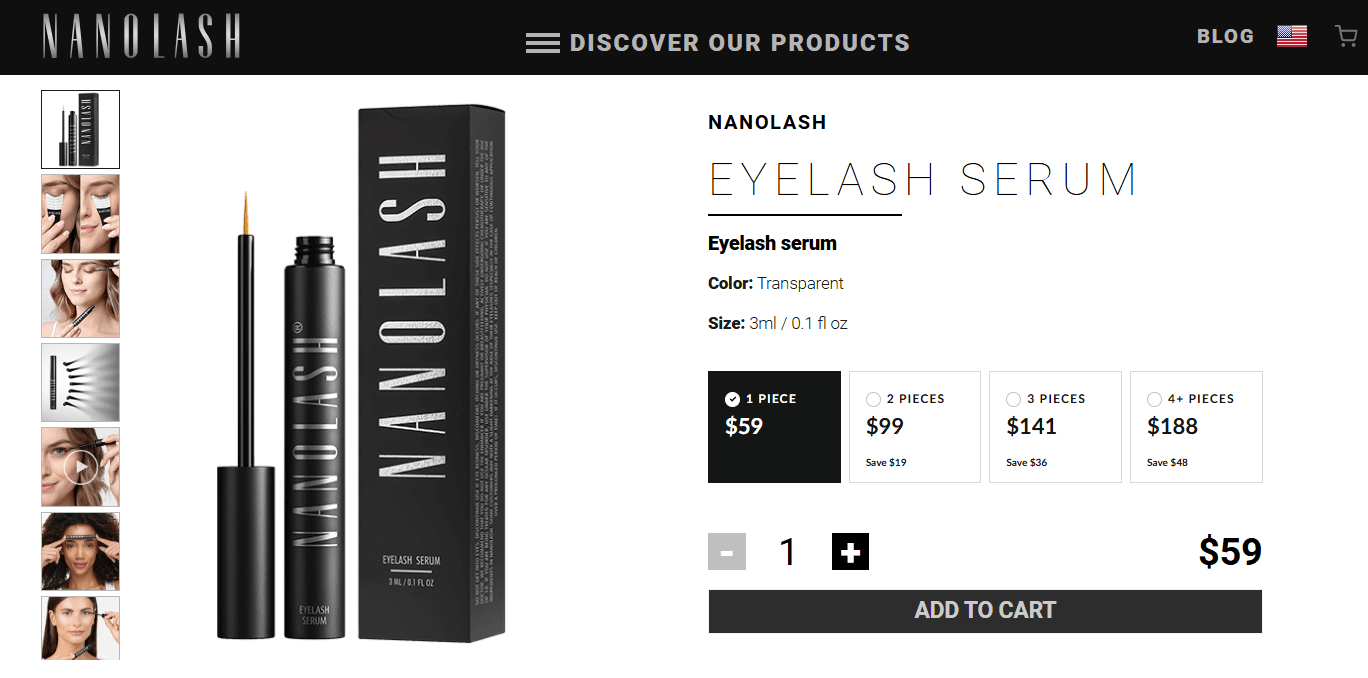
Nanolash Eyelash Serum is a real lash-growth product, and the original formula can produce visible lash-lengthening results, but its 2026 safety profile deserves serious consideration. The original 3 mL formula sold by Nanolash lists Ethyl Tafluprostamide as its second ingredient and claims that lashes can become up to 50% longer within 30 days.
The major issue is that Ethyl Tafluprostamide is a prostaglandin analogue. In February 2026, the European Commission’s Scientific Committee on Consumer Safety (SCCS) concluded that Ethyl Tafluprostamide and two other evaluated prostaglandin analogues could not be considered safe for use in cosmetic products intended to promote eyelash and eyebrow growth.
This does not mean that every person who has used Nanolash will experience a harmful reaction, nor does it mean the product is a scam. It means the original formula should not be described simply as a harmless cosmetic lash conditioner.
Nanolash now also sells a separate Peptide Eyelash Serum, which the brand presents as free from prostaglandins and prostaglandin analogues. That newer product has a different formula and should be evaluated separately.
Nanolash Eyelash Serum at a Glance
| Factor | What we found |
|---|---|
| Product | Nanolash Eyelash Serum |
| Original size | 3 mL / 0.1 fl oz |
| Main growth ingredient | Ethyl Tafluprostamide |
| Other listed ingredients | Eyebright extract, propylene glycol, sodium chloride, alcohol, phenoxyethanol, citric acid, triethanolamine |
| Seller’s growth claim | Up to 50% longer lashes in 30 days |
| Recommended use | Once daily |
| Maintenance | 2–3 times per week after desired results |
| European safety update | SCCS concluded evaluated prostaglandin analogues could not be considered safe for lash/brow-growth cosmetics |
| New alternative from brand | Nanolash Peptide Eyelash Serum |
| Overall assessment | Original formula has a significant safety concern; newer peptide formula is a separate product |
What Is Nanolash Eyelash Serum?
Nanolash Eyelash Serum is a cosmetic treatment marketed to make natural eyelashes look longer, thicker and darker.
The official product page says the serum should be applied once a day to clean skin at the base of the eyelashes. Once users achieve their desired results, Nanolash recommends reducing use to two or three times a week to maintain the effect.
The original serum comes in a small 3 mL container and is marketed internationally through Nanolash websites. The company also sells eyelash extensions, mascaras, lash-lift products and other eye-area cosmetics.
So there is little reason to question whether the product itself exists.
The more important questions are whether it works, what makes it work, and whether that ingredient is appropriate for cosmetic use around the eyes.
Does Nanolash Eyelash Serum Really Work?
There is evidence that the original formula can produce noticeable lash-growth effects.
Nanolash advertises the product as capable of making lashes up to 50% longer within 30 days. That figure is a company marketing claim and should not be interpreted as a guaranteed result for every user.
Independent experience also suggests that some users see visible results.
A 2026 beauty review from Nuvole di Bellezza reported positive personal results with the original Nanolash formula, describing lashes as longer and more defined after consistent use. However, the reviewer explicitly noted that personal experience is not equivalent to a clinical trial and ultimately said she would not choose the original formula again because of the updated safety concerns surrounding Ethyl Tafluprostamide.
That is an important distinction:
The fact that a formula works does not automatically mean that it has an acceptable safety profile.
The Ingredient That Changes This Review: Ethyl Tafluprostamide
The original Nanolash formula lists:
- Aqua
- Ethyl Tafluprostamide
- Euphrasia Officinalis Extract
- Propylene Glycol
- Sodium Chloride
- Alcohol
- Phenoxyethanol
- Citric Acid
- Triethanolamine
Ethyl Tafluprostamide is therefore not a minor ingredient buried near the end of the published INCI list. It is listed immediately after water.
The exact concentration cannot be determined simply from the order of ingredients.
This ingredient is important because it belongs to the family of prostaglandin analogues, substances with pharmacological activity that have been used in connection with eyelash growth.
What Did European Regulators Say in 2026?
This is the most significant finding for a current Nanolash review.
The European Commission’s Scientific Committee on Consumer Safety published its final opinion on February 10, 2026. The committee evaluated three prostaglandin analogues, including Ethyl Tafluprostamide, for use in eyelash and eyebrow products.
Its conclusion was that none of the three substances could be considered safe for use in cosmetic products intended to promote eyelash and eyebrow growth.
The SCCS cited their potent pharmacological activity and insufficient data to exclude potential adverse effects, particularly reproductive and developmental toxicity concerns.
The SCCS had already raised concerns about Ethyl Tafluprostamide and other prostaglandin analogues in an earlier 2022 opinion, noting the substances’ pharmacological activity and the particular concern associated with cosmetics applied close to the eye.
This is a scientific safety opinion, not evidence that Nanolash itself has injured customers.
It also should not be misrepresented as proof that the original Nanolash serum has been universally banned everywhere.
But it is highly relevant to consumers deciding whether to begin using a formula containing Ethyl Tafluprostamide.
What Side Effects Can Prostaglandin-Analogue Lash Serums Cause?
Research on cosmetic eyelash serums has identified several potential concerns associated with prostaglandin analogues.
A 2024 review in the Journal of Cosmetic Dermatology discusses adverse effects reported with different prostaglandin-analogue lash serums, including irritation, pigmentation changes and prostaglandin-associated changes around the eye. The review also emphasizes that several cosmetic prostaglandin analogues lack adequate safety research.
Reported concerns across this category can include:
- Eye irritation
- Redness
- Darkening of eyelid skin
- Changes in pigmentation around the eyes
- Periorbital changes
- Potential changes in the appearance of the area around the eyes
The precise risk depends on the individual ingredient, concentration, exposure and person.
Therefore, it would be incorrect to say that every Nanolash user will develop these effects.
Is Nanolash Safe During Pregnancy?
The official Nanolash information states that pregnancy and breastfeeding are contraindications for its original serum. It also says the product should not be used by minors.
That warning is particularly important given the 2026 SCCS assessment of Ethyl Tafluprostamide and related prostaglandin analogues.
Anyone who is pregnant, breastfeeding, trying to conceive, or dealing with an eye condition should speak with a qualified healthcare professional before using a lash-growth product containing pharmacologically active ingredients.
What About Contact Lens Wearers?
Nanolash’s official information says the serum can be used by people who wear contact lenses, but the product should still be applied carefully at the lash line and according to the manufacturer’s instructions.
Because the product is used immediately adjacent to the eye, avoiding direct eye contact is important.
If persistent redness, pain, swelling or visual changes occur, use should be discontinued and medical advice sought.
Is Nanolash Peptide Eyelash Serum the Same Product?
No.
This is an important distinction for anyone researching Nanolash reviews in 2026.
Nanolash’s current website lists both:
- Nanolash Eyelash Serum
- Nanolash Peptide Eyelash Serum
The brand describes the newer Peptide Eyelash Serum as a separate product. A 2026 independent review reports that the peptide version is a different 5 mL formula declared by the brand to be free of prostaglandins and prostaglandin analogues.
Therefore, a review of the newer peptide formula should not automatically be used to establish the safety or effectiveness of the original 3 mL Ethyl Tafluprostamide formula.
This distinction is especially important when shopping online because similarly named products can easily be confused.
Nanolash Reviews: What Do Users Say?
Customer and independent reviews are mixed, although many users report positive cosmetic results.
People who like the original serum commonly describe:
- Longer-looking lashes
- Fuller appearance
- Darker-looking lashes
- More defined eyes
- Noticeable results with consistent use
The independent 2026 reviewer mentioned above also reported positive personal results over multiple periods of use.
However, positive results do not eliminate the safety question raised by the SCCS.
That is why a simple “Nanolash works” conclusion is incomplete.
The more accurate conclusion is:
The original formula may be effective at producing visible lash-growth effects, but its key growth-promoting ingredient has raised significant European safety concerns.
How Long Does Nanolash Take to Work?
Nanolash advertises visible improvement within approximately 30 days and recommends daily application during the main treatment period.
However, eyelash growth naturally occurs in cycles, so individual results can take longer.
Current expert reviews of lash serums generally emphasize that results depend on the type of active ingredient. Prostaglandin-analogue formulas can produce noticeable changes over several weeks, while peptide and conditioning formulas generally require longer, consistent use.
This means dramatic “overnight” results should be treated skeptically.
What Happens When You Stop Using Nanolash?
The effect is not expected to remain permanently.
Eyelashes naturally shed and regrow. Once a growth-promoting serum is discontinued, the enhanced appearance generally decreases as treated lashes complete their natural growth cycle.
Nanolash itself recommends continued maintenance use two to three times per week after reaching the desired result.
This is another reason to think of lash serums as ongoing cosmetic treatments rather than permanent solutions.
Is Nanolash Eyelash Serum Legit or a Scam?
Nanolash is a real cosmetics brand, and the original eyelash serum is a genuine product.
The company operates an active official website and sells a broader range of eyelash and eyebrow products. It also lists retail partners and provides a formal returns process.
Therefore, calling Nanolash a scam would not be supported by the evidence reviewed.
The more significant issue is the safety of the original formula, not whether the product exists.
Nanolash has also introduced a separate peptide serum, which suggests consumers now have a different formula option within the brand.
Returns and Buying Considerations
Nanolash’s current U.S. return page states that customers generally have 14 days from receipt to withdraw from a purchase without giving a reason. The customer is responsible for return shipping, and refunds are processed within 14 days after the returned shipment is received.
Because product availability and regional consumer rights can vary, buyers should check the return terms for the specific country from which they are ordering.
Pros and Cons
Pros
- Established cosmetics brand with an active product range
- Original serum can produce visible lash-lengthening results for some users
- Easy once-daily application
- Small, simple formula
- International availability
- Brand now offers a separate peptide-based alternative
- Clear application instructions
Cons
- Original formula contains Ethyl Tafluprostamide
- 2026 European SCCS opinion concluded evaluated prostaglandin analogues could not be considered safe for lash/brow-growth cosmetics
- Potential concerns associated with prostaglandin analogues around the eyes
- Advertised 50% growth in 30 days is a manufacturer claim, not a guarantee
- Results require continued use
- Original and peptide versions can easily be confused
- Not appropriate to treat as a harmless conditioning serum
Frequently Asked Questions
Does Nanolash Eyelash Serum really work?
The original formula can produce visible lash-growth effects, according to manufacturer claims and some independent user experiences. However, individual results vary and the product’s effectiveness should be considered separately from its safety profile.
What is the active ingredient in the original Nanolash serum?
The official INCI lists Ethyl Tafluprostamide immediately after water.
Is Ethyl Tafluprostamide a prostaglandin?
It is a prostaglandin analogue. The European SCCS specifically evaluated Ethyl Tafluprostamide as one of three prostaglandin analogues used in eyelash and eyebrow cosmetics.
Is Nanolash Eyelash Serum safe?
The answer requires caution. In February 2026, the SCCS concluded that Ethyl Tafluprostamide and the other evaluated analogues could not be considered safe for cosmetic products intended to promote eyelash and eyebrow growth.
Is Nanolash banned?
The 2026 SCCS opinion should not be simplified into “Nanolash is banned.” The scientific committee issued a safety opinion concerning specific prostaglandin analogues and their use in lash/brow-growth cosmetics. Regulatory implementation is a separate process.
Does Nanolash contain prostaglandins?
The original formula contains Ethyl Tafluprostamide, which is a prostaglandin analogue.
Is the Nanolash Peptide Serum the safer option?
It is a separate formula that the brand describes as free of prostaglandins and prostaglandin analogues. That removes the specific Ethyl Tafluprostamide issue, although it does not guarantee that the product will work for everyone or that it cannot cause irritation.
Can I use Nanolash while pregnant?
The original Nanolash information lists pregnancy and breastfeeding as contraindications. Given the current European safety assessment of the active ingredient, anyone who is pregnant or breastfeeding should avoid experimenting with this type of lash-growth formula unless specifically advised by a healthcare professional.
Final Verdict
Nanolash Eyelash Serum is a genuine product that can produce visible lash-growth results, but the original formula is difficult to recommend in 2026 because of the safety concerns surrounding Ethyl Tafluprostamide.
Historically, the formula attracted users because it could produce a noticeable difference in lash length and definition. Independent personal experience also supports the possibility of visible results.
But the most important new evidence is the European SCCS’s February 2026 conclusion. The committee found that Ethyl Tafluprostamide and two other evaluated prostaglandin analogues could not be considered safe for cosmetic products intended to promote eyelash and eyebrow growth.
That makes a simple “Nanolash works, so buy it” recommendation inappropriate.
Bottom Line
The original Nanolash Eyelash Serum appears effective for lash growth in some users, but its Ethyl Tafluprostamide ingredient creates a significant safety concern in light of the 2026 European SCCS opinion.
If you’re considering Nanolash today, make sure you know which formula you are buying. The brand now sells a separate Peptide Eyelash Serum, which is marketed as prostaglandin-free and is a materially different product.
Overall verdict: legitimate product with evidence of cosmetic lash-growth effects, but the original formula is not the version I would recommend starting in 2026 given the updated safety assessment.
Don’t Miss: FaceLove Foundation Reviews

Nikhil Sharma is the author and researcher behind Review Trails, where he shares shopping website reviews, product insights, and scam or legit website analysis. He focuses on providing honest, easy-to-understand information that helps readers make safer and smarter online purchasing decisions.