
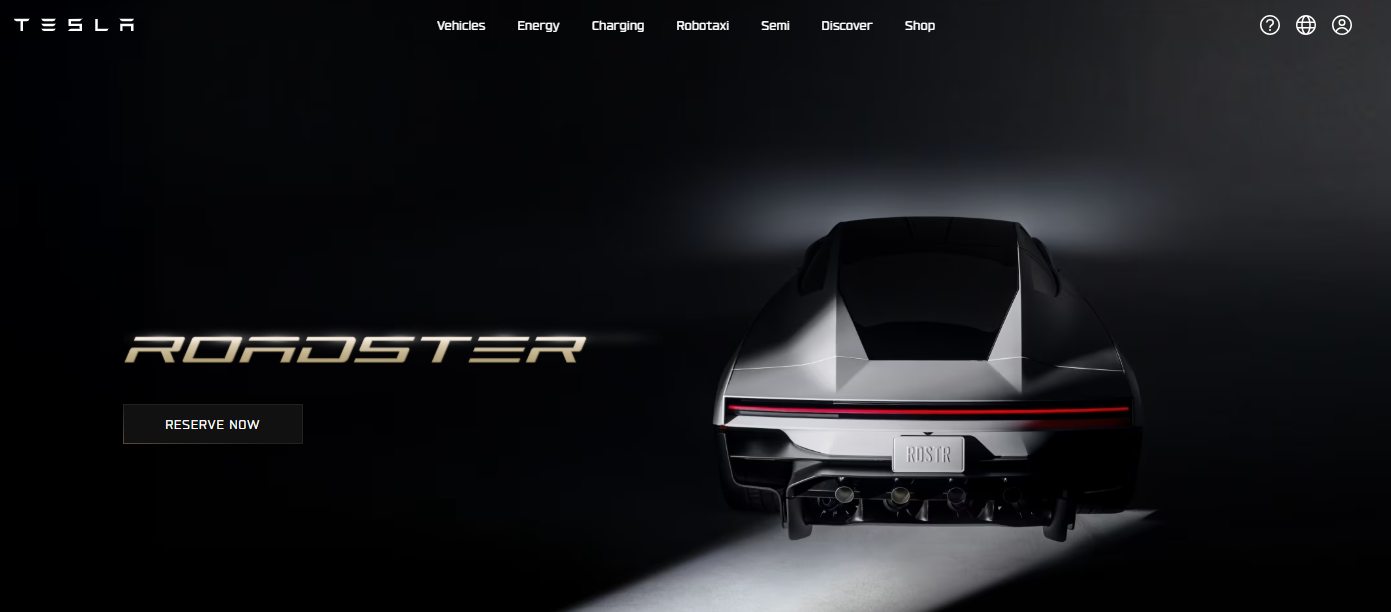
The Tesla Roadster has become one of the most anticipated electric sports cars in the world. Promising extreme acceleration, futuristic engineering, and performance intended to challenge traditional supercars, it has attracted attention from EV enthusiasts and luxury-car buyers for years.
But there is a major complication: the next-generation Roadster has faced repeated delays, and its advertised performance figures have not yet been fully validated in a production vehicle.
In October 2026, Tesla showcased a redesigned Roadster concept featuring new aerodynamic technology and optional cold-gas thrusters. The company is accepting reservations, but production is targeted for 2028, and delivery dates remain uncertain.
This Tesla Roadster review examines the latest announcements, advertised specifications, expected price, potential advantages, and major risks for prospective buyers.
Our verdict: The Roadster is an exciting engineering project, but it remains a high-risk reservation rather than a proven production car. Buyers should separate Tesla’s ambitious claims from features and performance that have been independently demonstrated.
What Is the Tesla Roadster?
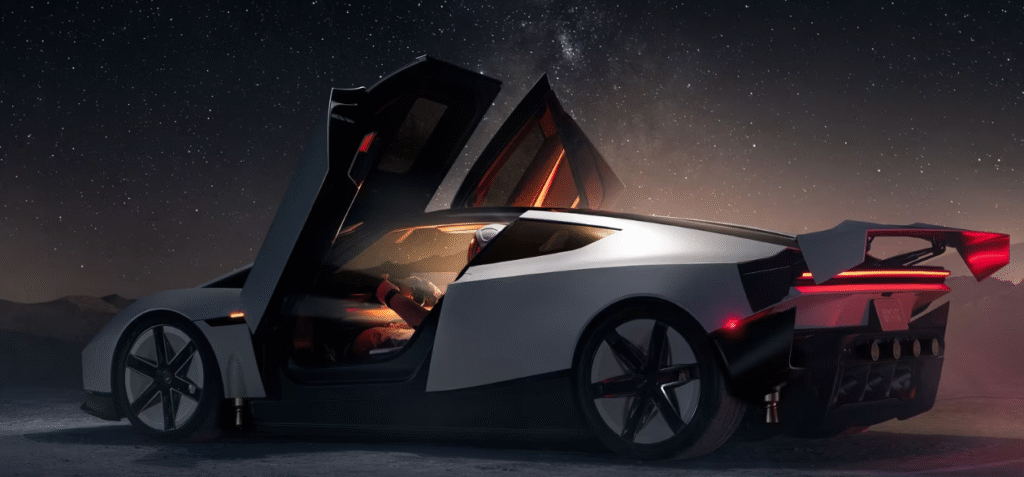
The next-generation <Entity value=”Tesla Roadster” category=”vehicle” disambig=”Tesla’s upcoming all-electric sports car” /> is an electric sports car announced by <Entity value=”Tesla” category=”brand” disambig=”electric vehicles and clean energy company” /> in 2017. It was originally presented as a high-performance vehicle capable of delivering acceleration and range well beyond what most electric cars offered at the time.
After years of delays, Tesla unveiled a redesigned version in October 2026. The latest concept emphasises aerodynamic downforce, advanced vehicle control systems, and optional rocket-inspired technology developed around cold-gas thrusters.
Tesla’s current presentation includes three configurations or performance packages: Performance, Thrust, and Rocket. These are not equivalent to three fully tested production models. The specifications, availability, and regulatory status of some features remain subject to change.
For buyers, the central question is no longer simply whether the Roadster sounds impressive. It is whether Tesla can turn the announced technology into a production vehicle that delivers the promised performance, safety, and usability.
Tesla Roadster Specifications
Tesla’s current website advertises headline figures for the Roadster, but the vehicle remains under development. Specifications should therefore be treated as manufacturer claims rather than independently verified production results.
| Feature | Advertised information |
|---|---|
| Vehicle type | All-electric sports car |
| Standard seating | Two seats in the latest Performance presentation |
| Original advertised acceleration | 0–60 mph in 1.9 seconds |
| Original advertised top speed | More than 250 mph |
| Original advertised range | 620 miles |
| Latest production target | 2028 |
| Aerodynamics | Active aerodynamic systems and multi-mode suction technology |
| Thrust package | Optional cold-gas thrusters |
| Rocket configuration | Invitation-only concept with airborne manoeuvre capability claimed by Tesla |
| Confirmed final retail price | Not established |
| Delivery date | Not guaranteed |
The original performance and range figures come from Tesla’s earlier Roadster presentation. They should not automatically be applied to the redesigned vehicle, whose final production specifications have not been comprehensively confirmed.
Performance and Acceleration
Acceleration is central to the Roadster’s appeal. Tesla originally advertised a 0–60 mph time of 1.9 seconds, positioning the car among the most ambitious electric performance vehicles ever announced.
The latest Thrust package goes further. Tesla claims acceleration from 0–60 mph in under one second, using cold-gas thrusters alongside other performance technology.
These claims are extraordinary, but buyers should understand the difference between a manufacturer demonstration and independently verified production performance. A prototype or special demonstration vehicle does not establish that every customer car will achieve the same figures under normal conditions.
The eventual performance will depend on the final hardware, tyres, road surface, battery condition, software, and applicable safety restrictions.
For enthusiasts, the Roadster’s proposed acceleration could be spectacular. For a buyer considering a reservation, however, the important question is when independent tests of a production-ready vehicle will become available.
Aerodynamics and the Multi-Mode Suction System
One of the most unusual elements of Tesla’s latest Roadster presentation is its multi-mode fan and ground-sealing system.
Tesla says the system can generate downforce by pulling air from beneath the car. In principle, increasing downforce can improve tyre grip and cornering performance, particularly at high speeds.
The concept also incorporates active aerodynamics and a steer-by-wire system. These technologies could give the Roadster greater flexibility between low-drag cruising and high-downforce track driving.
However, the effectiveness, durability, noise levels, energy consumption, and real-world safety of the complete system remain important questions. Its performance cannot be judged from promotional footage alone.
The technology is ambitious, but buyers should wait for independent testing before assuming that its advertised benefits will translate into predictable everyday handling.
Can the Tesla Roadster Really Fly?
Tesla’s Rocket configuration has attracted attention because the company describes a system of cold-gas thrusters capable of supporting upward and forward movement.
This is not a conventional road-car feature. It introduces substantial engineering and regulatory challenges involving vehicle stability, compressed gas, occupant protection, operating environments, and public safety.
Tesla explicitly notes that the Rocket configuration is not approved for public-road use. Its availability is also restricted to an invitation-only programme, and the final specifications may change.
It is therefore misleading to treat the Roadster as an ordinary production car that buyers will be able to drive through the air on public roads. The claimed airborne capability belongs to a specialised configuration whose practical use and legal status are very different from those of a conventional sports car.
For most buyers, the more relevant questions concern the standard vehicle’s acceleration, braking, range, handling, comfort, and reliability.
Battery, Range and Charging
The original Roadster announcement included a claimed range of 620 miles. Tesla’s latest redesign has not established a complete, independently validated production specification that confirms this figure will apply to the new vehicle.
Range is affected by battery capacity, vehicle weight, aerodynamics, temperature, driving speed, tyres, and accessory use. High-speed driving in particular can significantly reduce the distance an electric performance car travels between charges.
Potential buyers should wait for confirmation of the production battery, charging performance, charging connector, and official range-testing standard.
The original range claim is impressive, but it should not be treated as a guarantee for the redesigned Roadster.
Interior, Seating and Practicality
The Roadster’s interior has also evolved since the original concept. Tesla’s latest presentation describes the Performance configuration as a two-seat vehicle, rather than relying on the four-seat layout advertised for the earlier version.
The focus is on a minimalist, driver-oriented cabin and advanced performance technology. The company has also promoted lightweight construction materials and a removable glass roof in earlier presentations, although buyers should verify which features will survive into the final production model.
A sports car built around extreme performance will inevitably make compromises. Ride comfort, luggage space, visibility, cabin noise, and ease of entry may matter less to a track-focused enthusiast than to someone intending to use the vehicle regularly.
Because the production interior and equipment list are not fully established, it is too early to offer a reliable verdict on everyday comfort.
Tesla Roadster Price and Reservations
The final retail price of the redesigned Roadster has not been firmly established. Tesla’s reservation agreement states that the vehicle remains under development and that any estimated purchase price is not final.
In India, Tesla opened reservations in October 2026. Reporting on the Indian reservation structure indicates total reservation payments of approximately ₹50.06 lakh for the Performance configuration and ₹2.50 crore for the Thrust configuration. These are reservation amounts, not confirmed final vehicle prices.
The payment structure reported for India includes an initial payment followed by a much larger balance due within 10 days. Buyers should review the current Tesla agreement carefully before committing funds.
Tesla’s reservation agreement also makes clear that a reservation does not constitute a completed vehicle purchase and that a delivery date is not guaranteed.
Before paying, prospective buyers should verify:
- The total reservation payment and cancellation terms.
- Whether the payment is refundable under the specific agreement.
- The estimated final price, taxes, and delivery charges.
- Whether the vehicle will be available in their country.
- Whether a right-hand-drive version will be offered.
- Whether the selected performance package is approved for local use.
For the latest terms, consult Tesla’s official Roadster page rather than relying solely on third-party summaries.
Is the Tesla Roadster Worth Buying?
The Roadster is appealing because it promises technology and performance that could distinguish it from conventional electric sports cars. Its proposed aerodynamics, acceleration, and optional thruster systems are genuinely ambitious.
However, its value proposition remains difficult to evaluate without a confirmed production price, final specifications, independent performance tests, and a reliable delivery schedule.
The history of delays is especially relevant. The previous generation was announced years ago but never reached general production as originally anticipated. That history does not prove the redesigned vehicle will fail to arrive, but it gives prospective buyers a reason to be cautious about making plans around an estimated date.
For someone who simply wants a fast electric car now, an established production model offers a much clearer picture of price, performance, warranty, and availability. The Roadster is more suitable for a buyer who understands the uncertainty and is comfortable waiting.
Pros and Cons of the Tesla Roadster
Potential advantages
- Ambitious electric sports-car performance.
- Promising aerodynamic and downforce technology.
- Optional high-performance Thrust package.
- Potentially groundbreaking engineering.
- Strong appeal for collectors and EV enthusiasts.
Major disadvantages
- Production is not expected to begin until 2028.
- Final pricing and specifications remain uncertain.
- Advertised performance figures are not yet fully validated in a production car.
- The vehicle has a history of delays.
- Some specialised features may not be legal for public-road use.
- Reservation payments can be substantial.
- Right-hand-drive availability and regional delivery timing remain uncertain.
Is the Tesla Roadster a Scam?
The Tesla Roadster is a real Tesla development project, not simply an anonymous product being sold through an unfamiliar online store. However, that does not mean every advertised capability is already proven or that reserving one guarantees a specific delivery date.
The key issue is uncertainty, rather than evidence that the car itself is fraudulent. Tesla’s own reservation terms state that the vehicle remains under development and that delivery cannot be guaranteed.
Buyers should avoid treating promotional demonstrations as proof of production performance. They should also read the reservation agreement closely and ensure that the amount paid, refund process, and cancellation conditions are understood.
Frequently Asked Questions
When will the Tesla Roadster be released?
Tesla is targeting production in 2028, but it has not guaranteed when individual customers will receive their vehicles. Regional delivery dates remain uncertain.
How fast is the Tesla Roadster?
Tesla’s original presentation advertised 0–60 mph in 1.9 seconds and a top speed above 250 mph. The latest Thrust configuration is claimed to reach 60 mph in under one second, but these claims should not be treated as independently verified production performance.
What is the Tesla Roadster’s price?
The final retail price has not been confirmed. Reservation amounts in India have been reported at approximately ₹50.06 lakh for Performance and ₹2.50 crore for Thrust; these are not final vehicle prices.
Can the Tesla Roadster fly?
Tesla describes an invitation-only Rocket configuration with cold-gas thrusters intended to support airborne manoeuvres. It is not approved for public-road use, and its final availability and practical capabilities remain uncertain.
Is the Roadster available in India?
Tesla has opened reservations in India, but this does not mean customer deliveries are imminent. Production timing, final pricing, and right-hand-drive availability remain unresolved.
Should I reserve a Tesla Roadster now?
Only if you fully understand the financial commitment and can tolerate substantial uncertainty about specifications and delivery. Read the current reservation agreement and confirm refund conditions before paying.
Final Verdict
The Tesla Roadster remains one of the most ambitious electric sports-car projects on the market. Its proposed acceleration, advanced aerodynamics, and specialised thruster technology make it an intriguing prospect for enthusiasts.
But an impressive demonstration is not the same as a proven production vehicle. With production targeted for 2028, final specifications still subject to change, and delivery dates unguaranteed, buyers must account for substantial uncertainty.
Our recommendation: Admire the technology, but reserve cautiously. If you need a high-performance car in the near term, consider an established production vehicle with independently tested performance and a clear warranty. If you want the Roadster specifically, follow Tesla’s official updates and do not commit money until you understand the reservation terms and the risks involved.
Disclosure: This review is based on publicly available manufacturer information and news reporting, not a hands-on test of a production Roadster. Specifications, pricing, reservation conditions, and delivery plans may change.

Nikhil Sharma is the author and researcher behind Review Trails, where he shares shopping website reviews, product insights, and scam or legit website analysis. He focuses on providing honest, easy-to-understand information that helps readers make safer and smarter online purchasing decisions.